
Salary is usually the first number in a hiring budget. It is also only one part of the bill.
By the time a new developer starts, your team has already defined the role, reviewed profiles, run interviews and made an offer. Delivery may have slowed while the seat was open. The budget may also include employer contributions, equipment, access and onboarding. If the hire leaves early, some of those costs may have to be paid again.
Some of these costs are fixed by Polish rules. Others depend entirely on your team and the role. Keeping those two groups separate produces a much more useful budget than relying on a universal “cost per hire” figure.
The figures and examples below are for budgeting only, not legal, tax or payroll advice. Before hiring, confirm the current rules and the details of the engagement with a qualified Polish adviser.
Start with the hiring model, not the salary
The same hire can carry very different headline costs depending on how the engagement is structured. A lower rate may simply mean that payroll, benefits, equipment or compliance sits somewhere else.
| Engagement model | Main cost lines to budget | Questions to resolve before comparing prices |
|---|---|---|
| Direct employment | Gross salary, employer-financed contributions, benefits, PPK where applicable, payroll administration, recruitment, equipment and onboarding | Who is the employer? Which benefits and employer contributions apply? Who owns payroll and compliance? |
| B2B cooperation | Contractor invoice, recruitment, legal and procurement review, access and security setup, equipment if provided, internal management time | Is the quoted amount net or gross of VAT? Who contracts and pays the supplier? What does the agreement include? |
| Employer of Record (EOR) | Employee compensation and on-costs, benefits, EOR charges, recruitment, equipment and onboarding | Which employment, payroll and compliance services are included? What deposits, notice terms and extra charges apply? |
| Staff augmentation | Provider charges, internal onboarding and management, access and security, handover and continuity planning | Which administrative services, notice terms and replacement support are included in the provider agreement? |
The “B2B” label is not conclusive on its own. Poland’s State Labour Inspection looks at how the work is actually organised: subordination, place and time of work, and who carries the business risk all matter.
Direct employment from abroad raises a different question. A company hiring an employee to work in Poland may need to register locally as an employer and for social security; Your Europe explains the general rule.
Whichever model you choose, give employment, payroll and compliance a clear owner. RemoDevs’ recruitment scope covers role calibration, sourcing, screening and process coordination. An EOR can take on employment administration, but its exact responsibilities come from the EOR agreement.
What direct employment actually costs
Begin with the right salary number
A benchmark is only useful if you know exactly what it describes. Role, seniority, stack and location all matter, as does the contract behind the number. A monthly gross salary under an employment contract is not comparable with a B2B amount quoted net of VAT.
Useful starting points include the RemoDevs 2026 Polish IT Market Report, and the Polish IT Community Report 2025. None should be copied straight into a hiring plan. Check the range against people currently available for the role you need.
It also helps to keep the working model in PLN. If the final budget is reported in another currency, note the date and exchange rate rather than letting conversion differences blur the comparison. The National Bank of Poland publishes official exchange-rate tables.
Add what the employer pays on top
On an employment contract, PLN 20,000 gross is not a PLN 20,000 monthly cost to the company. The current ZUS table puts the employer-financed old-age pension contribution at 9.76% and the disability contribution at 6.50%. Accident insurance ranges from 0.67% to 3.33%; ZUS gives 1.67% for specified smaller payers.
There are smaller items too. Where they apply, the Ministry of Family, Labour and Social Policy’s rates table lists 1.00% for the Labour Fund, 1.45% for the Solidarity Fund and 0.10% for the Guaranteed Employee Benefits Fund.
PPK can add another employer payment. For an employee who participates, the official PPK portal states that the basic employer payment is 1.5% of remuneration. An employer may choose to pay more.
These percentages are not a plug-and-play payroll calculator. Contribution bases, annual limits, exemptions, PPK participation and the employer’s accident rate can change the result. A Polish payroll or legal adviser should confirm the assumptions for the actual hire.
What this looks like at PLN 20,000 gross
Here is a worked example with the assumptions left visible. It uses a monthly gross salary of PLN 20,000, an accident-insurance rate of 1.67%, all listed funds applying, no reliefs or annual-limit effects, and no PPK participation. It is not a salary benchmark or a RemoDevs price.
| Cost line | Calculation | Annual amount |
|---|---|---|
| Gross salary | PLN 20,000 × 12 | PLN 240,000 |
| Employer old-age pension contribution | PLN 240,000 × 9.76% | PLN 23,424 |
| Employer disability pension contribution | PLN 240,000 × 6.50% | PLN 15,600 |
| Employer accident contribution | PLN 240,000 × 1.67% | PLN 4,008 |
| Labour Fund | PLN 240,000 × 1.00% | PLN 2,400 |
| Solidarity Fund | PLN 240,000 × 1.45% | PLN 3,480 |
| Guaranteed Employee Benefits Fund | PLN 240,000 × 0.10% | PLN 240 |
| Employer-financed contributions and funds | Sum of the six lines above | PLN 49,152 |
| Salary plus listed employer costs | PLN 240,000 + PLN 49,152 | PLN 289,152 |
Under those assumptions, the annual total is PLN 289,152 before PPK, benefits, payroll services, recruitment, equipment or onboarding. Basic employer PPK at 1.5% would add PLN 3,600 if the employee participated.
Treat the recruitment fee as a contract term
People often look for a typical agency percentage. It is a shaky basis for a budget. Recruitment may be priced as a fixed fee, a percentage, a retainer or a success fee, and the same headline number can cover very different work.
A quote becomes comparable only when it answers a few practical questions:
- What is the calculation base, and does VAT or currency conversion apply?
- What event triggers the invoice?
- Which parts of sourcing, screening and coordination are included?
- What do the cancellation, exclusivity and replacement clauses actually say?
RemoDevs offers a success-fee recruitment option, with the fee linked to a successful hire. The amount, payment trigger and any replacement support depend on the model and contract agreed for the search. Use those terms when building the budget.
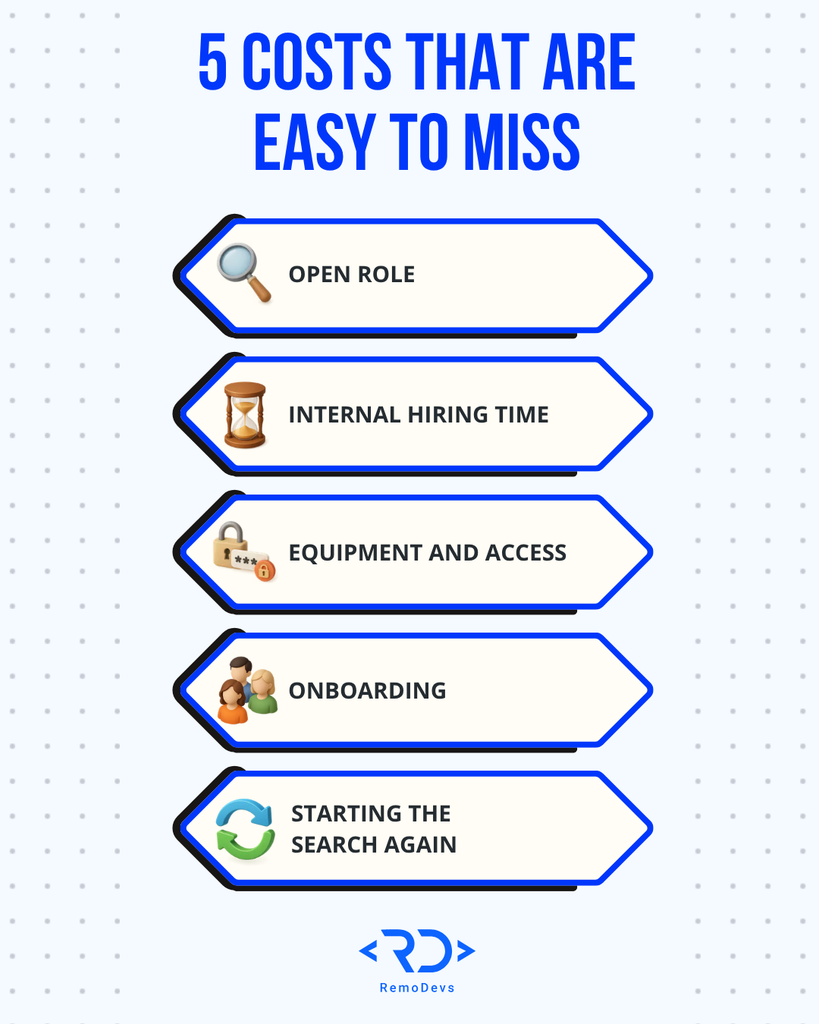
Costs that tend to surface later
The time already sitting in your team’s calendars
Hiring uses more internal time than the interviews themselves. Someone defines the role, reviews profiles, prepares questions, writes scorecards, joins debriefs, approves the offer and keeps the candidate informed. Senior engineers and managers are often the most expensive people in that chain.
The cleanest estimate comes from the process you intend to run. Multiply each participant’s expected hours by their hourly cost to the company, then add recruitment tools and job advertising. A specialist recruiter may take on much of the sourcing and initial screening. Your team still owns the interviews and hiring decision.
What waits while the seat is empty
An open role has no universal daily price. Start with the work waiting for that person. Will a milestone move? Will the company buy contractor capacity, ask the team to work overtime or remove something from the roadmap? Is customer revenue genuinely at risk, or is the effect mainly an internal delay?
It is usually enough to model low, expected and high scenarios. Keep revenue separate from profit, and write down the operational assumption behind each number. A visible assumption is much easier to challenge than a borrowed “cost per day”.
Dropouts and restarts
A candidate who withdraws late in the process can send the team back through profile review, interviews and approvals. Your own funnel shows where people leave, why they leave and which work has to be repeated. That gives you a clear place to improve the process.
Getting someone ready to work
The laptop is only the obvious part. There may also be peripherals, software licences, identity and access management, security checks, shipping and IT support. Under a B2B or staff-augmentation arrangement, agree who supplies each item instead of assuming it sits inside the quoted rate.
Then comes the ramp-up. A start date is not the same as productive capacity. Manager and buddy time, technical onboarding, documentation and training all belong in the model. Build the estimate around the milestones in your own onboarding plan.
When a hire leaves early
An early departure can bring back several costs at once: another search, a new vacancy period, repeated onboarding and offboarding. There may be rework or a delayed release too, but only include those effects when you can tie them to the role.
For an expected-cost model, use the probability of an early departure multiplied by the additional cost it would cause. Subtract anything recoverable under the recruitment contract and avoid counting vacancy or onboarding twice. Keep the full downside as a separate scenario rather than presenting it as the expected bill.
Build two totals, not one
One number should show the first-year commitment if the hire goes to plan. A second can add the expected impact of the vacancy and the estimated cost of an early departure. Keeping them apart stops operational risk from being mistaken for an invoice.
| Budget line | Input or calculation | Source or record |
|---|---|---|
| Cash compensation | Monthly amount × paid periods, plus contractual bonus | Approved compensation range and offer |
| Employer contributions | Payroll calculation by component | Current ZUS rates and payroll assumptions |
| PPK and benefits | Employer cost for the selected package | Policy and employee participation assumptions |
| External recruitment | Contracted fee or formula | Agency agreement and invoice trigger |
| Internal recruitment | Expected hours × hourly cost to the company | Interview plan and actual time |
| Equipment and access | Actual purchase and setup cost | IT and security checklist |
| Onboarding | Manager, buddy and training time | Onboarding plan |
| Base first-year cost | Compensation or provider charges + employer on-costs + recruitment + internal time + setup and onboarding | Saved cost model with an owner and date |
| Vacancy impact | Low, expected and high scenarios | Delivery plan, cover cost or margin assumption |
| Expected cost of an early departure | Estimated chance × extra replacement cost, after recoveries | Contract terms and scenario assumptions |
| Expected planning total | Base cost + expected vacancy impact + expected cost of an early departure | Assumptions checked for double counting, with the full downside shown separately |
Revisit the model whenever the salary range, hiring model, start date or exchange rate changes. It should stay useful while the search is running, not become a spreadsheet that was accurate only on approval day.
Where RemoDevs changes the calculation
A specialist recruiter changes some lines in this budget, not all of them. We help international companies hire software engineers, AI and data specialists, DevOps professionals and technical leaders in Poland. We work with your team to calibrate the role, source and screen candidates, and keep the process moving. You choose whom to interview and hire.
For most searches, we aim to present the first qualified candidates within five working days after role calibration. Seniority, stack, role complexity and current availability can all affect how quickly the search moves.
Before the search begins, we agree the fee, when it is payable and any replacement support with you. Payroll is treated separately from the recruitment fee and assigned under the chosen hiring model. We can take much of the sourcing and screening load off your team; you will still need to plan for interviews, the employment or contracting setup, onboarding and day-to-day management.
Planning a hire in Poland? Tell RemoDevs about the role, and we will talk you through the candidate market and what the search is likely to involve.
Frequently asked questions
How much does it cost to hire a developer in Poland?
It depends on the role, seniority, technology, engagement model and benefits. For direct employment, start with annual gross compensation, then add the relevant employer contributions, recruitment, internal time, equipment, onboarding and the estimated impact of the vacancy. For B2B or staff augmentation, start with the contracted invoice or provider rate and check what it already includes.
In the hypothetical example above, PLN 20,000 gross per month produces PLN 289,152 in annual salary plus the listed employer contributions and funds. This is before PPK, benefits, recruitment, payroll services, equipment and onboarding, and it is not a salary benchmark or RemoDevs price.
Are Polish employer contributions included in gross salary?
No. Under an employment contract, several employer-financed contributions sit on top of gross salary. Their actual value depends on the contribution base, applicable funds, PPK participation, limits, exemptions and the employer’s accident-insurance rate. Use a payroll calculation for the specific hire.
What is a typical recruitment fee?
Agencies use success fees, retainers, fixed fees and percentage-based pricing. Compare the formula, scope, payment trigger and replacement terms in the proposal rather than relying on a broad market average.
How quickly can RemoDevs present candidates?
For most searches, RemoDevs aims to present the first qualified candidates within five working days after role calibration. The realistic timeline depends on the seniority, technology stack, complexity of the role and current market availability.
Does a RemoDevs recruitment fee include payroll?
No. Payroll is treated separately from the recruitment fee. The recruitment scope described here covers sourcing, screening and process coordination. Responsibility for employment, payroll, tax and social-security administration is agreed under the chosen hiring model. If an EOR is involved, its own agreement should state which payroll and employment services are included.
What happens if a candidate hired through RemoDevs leaves?
Check the signed agreement. Replacement support, its duration, conditions and exclusions depend on the recruitment model and contract.
Visit us
Find a moment in your calendar and come to our office for a delicious coffee
Make an apointment