
Setting up a remote engineering team in Poland gives your company access to some of the most skilled technical talent in Europe. However, integrating international developers into your existing workflows requires aligning your schedules accurately.
Managing Polish holidays effectively is crucial for precise sprint planning, maintaining consistent product delivery, and maximizing timezone overlap. This guide explains exactly how time off works in Poland, outlining statutory minimums, contract differences, and key dates tech leaders need to watch.
Why Understanding Polish PTO Matters for Tech Leaders
For CTOs and Engineering VPs, a developer’s time off isn’t just an HR detail; it directly impacts project timelines. Missing a local public holiday in your resource planning can leave you short-handed during a critical release.
Understanding Polish PTO allows tech leaders to accurately forecast sprint velocity, adjust story points ahead of long weekends, and set realistic delivery expectations. When you anticipate these dates, you integrate your Polish developers seamlessly, treating local holidays as a predictable variable rather than a sudden roadblock.
Standard Polish PTO Rules Explained (20 vs. 26 Days)
Under standard Polish labor law, an Employment Contract (Umowa o Pracę, or UoP) guarantees a specific amount of paid time off based on an employee’s total “work experience.”
- 20 days of PTO: Granted to employees with less than 10 years of experience.
- 26 days of PTO: Granted to employees with 10 or more years of experience.
This system has a unique calculation: higher education counts toward this total. A university degree automatically adds 8 years of “experience” to the calculation. Therefore, a software engineer with a degree only needs two years of actual employment to reach the 26-day tier. You should assume that almost all mid-level and senior developers qualify for 26 days of PTO.
Additionally, Polish labor law includes a “Saturday rule.” If an official public holiday falls on a Saturday, employers are legally required to grant employees an alternative day off during the standard workweek. Holidays falling on a Sunday do not grant an extra day off.
B2B vs. Employment Contracts (UoP): How Time Off Works
The rules above apply strictly to UoP contracts. However, the Polish tech sector operates differently.
The vast majority of senior IT professionals in Poland prefer B2B (Business-to-Business) contracts due to greater flexibility and tax efficiency.
Before agreeing on time-off arrangements for Polish engineers, review our guide to hiring software developers in Poland to understand the differences between employment, independent B2B cooperation, and staff augmentation.
Legally, a B2B contractor is an independent business. They are not entitled to statutory PTO under the Polish Labor Code.
Practically, to attract and retain top-tier global talent, foreign companies must offer competitive conditions. B2B contracts in the IT sector almost always include 20 to 26 days of commercially negotiated “paid breaks.”
Real-World B2B Example: Instead of legally binding “vacation days,” a compliant B2B agreement might state: “The Contractor is entitled to 26 paid non-working days per calendar year, during which the monthly remuneration remains unchanged.” This functions exactly like PTO for the developer while remaining fully compliant for accounting purposes.
Complete List of Polish Public Holidays
Poland observes 13 official public holidays each year.
Fixed-Date Holidays
These holidays fall on the same date every year:
- New Year’s Day: January 1
- Epiphany: January 6
- Labor Day: May 1
- Constitution Day: May 3
- Armed Forces Day / Assumption of Mary: August 15
- All Saints’ Day: November 1
- Independence Day: November 11
- Christmas Day: December 25
- Boxing Day: December 26
Movable Holidays
These dates change annually based on the lunar calendar. Here is when they fall in 2026:
- Easter Sunday: April 5
- Easter Monday: April 6
- Pentecost Sunday: May 24 (Always on a Sunday, so it does not affect the standard workweek)
- Corpus Christi: June 4 (Always falls on a Thursday, 60 days after Easter)
| Date (2026) | Holiday Name | Type | Sprint Planning Note |
| January 1 | New Year’s Day | Fixed | Standard day off. |
| January 6 | Epiphany | Fixed | Standard day off. |
| April 5 | Easter Sunday | Movable | No impact (Sunday). |
| April 6 | Easter Monday | Movable | Plan for a 4-day workweek. |
| May 1 | Labor Day | Fixed | Majówka Warning: High risk of May 2 PTO. |
| May 3 | Constitution Day | Fixed | Majówka Warning: Expect multi-day absences. |
| May 24 | Pentecost Sunday | Movable | No impact (Sunday). |
| June 4 | Corpus Christi | Movable | Long Weekend Warning: Falls on Thursday; expect Friday PTO. |
| August 15 | Armed Forces Day | Fixed | Standard day off. |
| November 1 | All Saints’ Day | Fixed | Standard day off. |
| November 11 | Independence Day | Fixed | Standard day off. |
| December 25 | Christmas Day | Fixed | Major holiday break. |
| December 26 | Boxing Day | Fixed | Major holiday break. |
Beware of “Majówka” and Long Weekends
Certain calendar layouts in Poland predictably lead to mass time off.
The most famous is Majówka, a national cultural phenomenon in early May. Because May 1 (Labor Day) and May 3 (Constitution Day) are both public holidays, developers frequently take May 2 off. If May 1 falls on a Tuesday or Thursday, taking just one or two days of negotiated time off can yield a continuous nine-day break.
Corpus Christi is another prime example. Because it always falls on a Thursday, developers routinely request the Friday off to create a four-day weekend.
Example for Tech Leaders: If a U.S.-based CTO is running a standard two-week sprint that overlaps with Majówka, they should proactively reduce the sprint’s total story points by 20-30% for the Polish team members, rather than expecting standard velocity.
Best Practices for Managing Polish Holidays in Distributed Teams
Use these strategies to keep your engineering operations smooth:
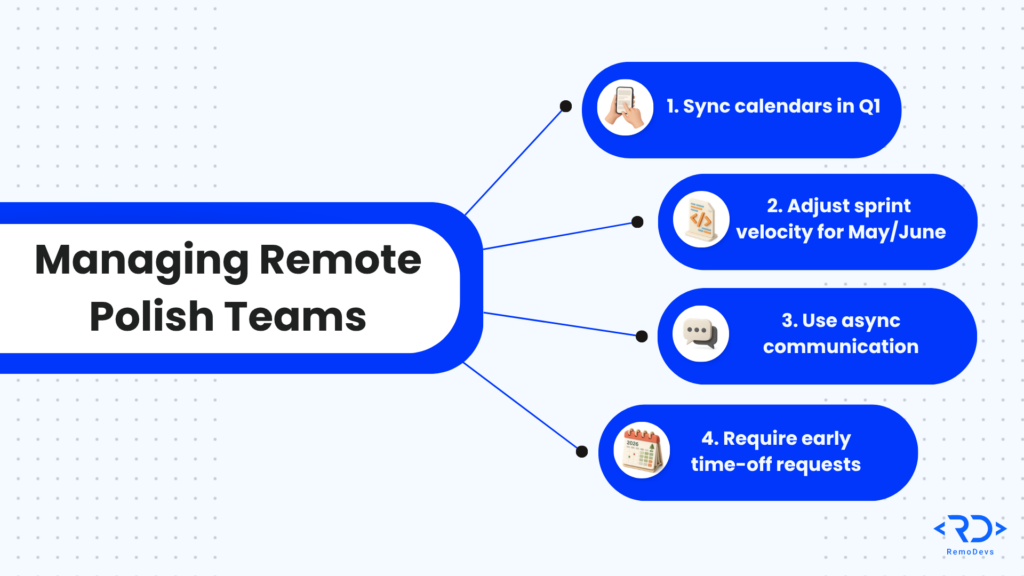
- Audit schedules early: Sync your company calendar with Polish holidays at the start of Q1.
- Adjust sprint velocity: Automatically lower expected output during May, June, and December to account for bridging days and major holidays.
- Rely on asynchronous communication: Ensure that documentation, Jira tickets, and GitHub pull requests are highly detailed. If your Polish developers are off for Corpus Christi, your North American or UK team can continue working without being blocked.
- Standardize time-off requests: Require all remote developers to log their negotiated paid breaks at least two sprints in advance.
To see how global tech leaders effectively run integrated teams, explore our case studies detailing how we’ve helped companies reduce time-to-hire by 40% and seamlessly scale their engineering output.
How RemoDevs Simplifies Polish Payroll and Compliance
Navigating international labor laws, tracking Saturday holiday rules, and drafting compliant B2B contracts can easily become a full-time administrative burden.
RemoDevs eliminates this friction. Backed by our extensive industry experience and a rigorous, multi-stage technical and soft-skills vetting process, we connect tech companies with top-tier Polish developers perfectly matched to your stack. We handle the local legalities, payroll processing, and PTO tracking entirely, absorbing all the compliance risk.
Focus on building software, not learning Polish labor codes.
Schedule a consultation to discuss adding senior Polish developers to your engineering team today.
FAQ
How many public holidays are there in Poland? Poland has 13 official public holidays annually. Nine are fixed dates, and four are movable based on the Easter calendar.
Do Polish developers on B2B contracts get paid time off? Legally, B2B contractors do not receive statutory PTO. However, standard industry practice dictates negotiating 20 to 26 days of “paid breaks” into the commercial contract to remain competitive for top tech talent.
What happens if a Polish public holiday falls on a Saturday? Under an Employment Contract (UoP), employers must grant the employee a different day off during the standard workweek. This rule does not apply if the holiday falls on a Sunday, nor does it legally apply to B2B contractors unless explicitly stated in their agreement.
Visit us
Find a moment in your calendar and come to our office for a delicious coffee
Make an apointment