
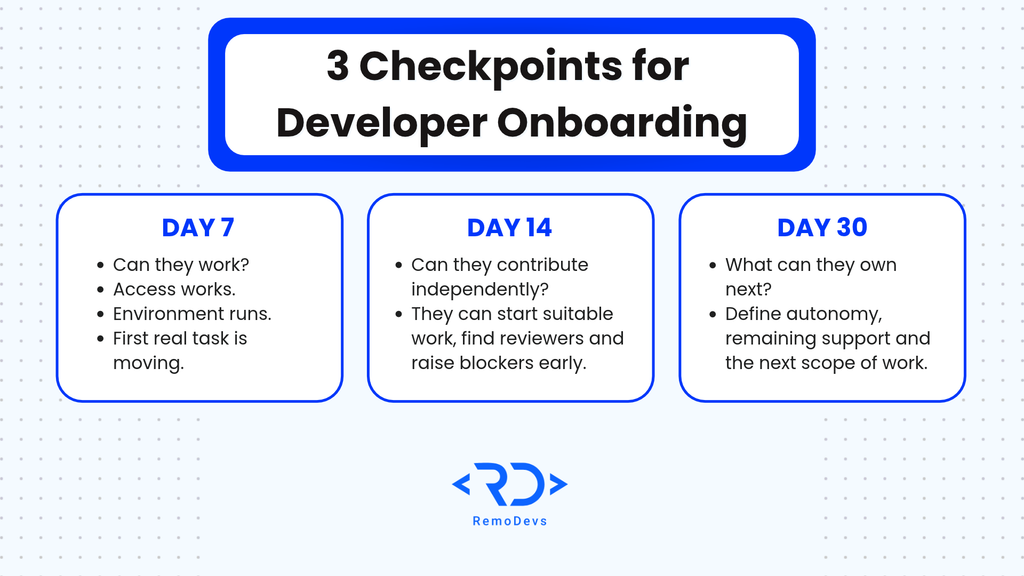
An augmented developer can be selected, contracted and ready to start while the engineering team is still unprepared to work with them. The first month needs a path through five things: working access, product and architecture context, a first accepted contribution, repeatable delivery and appropriate ownership. Assign a client-side engineering owner, prepare the systems before the start date, and use the Day 7, 14 and 30 reviews below to remove friction.
Adjust the checklist to the role: a data engineer may need a sandbox and pipeline run; a security specialist may deliver a reviewed assessment instead of a pull request. The test is whether the specialist can complete real work through your normal process.
Staff augmentation onboarding is an engineering responsibility
In client-managed staff augmentation, the specialist works inside the client’s tools and delivery process. The client sets priorities, supplies technical context, reviews work and decides what is accepted. The provider can coordinate the start and support the engagement, but cannot grant access to the client’s repository or make its architecture decisions. This is the responsibility split described on RemoDevs’ staff augmentation service page. If you are still deciding whether this operating model fits, read the Staff Augmentation Buyer’s Guide first.
Appoint an engineering manager or tech lead to own the plan and clear internal blockers. Give the specialist the team’s normal route to tickets, reviews and decisions, with role-specific access.
The 30-day staff augmentation onboarding checklist
Copy these rows into your team’s onboarding document. “Done” means the developer has demonstrated the outcome, not that an invitation was sent or a meeting appeared on the calendar.
| Timing | Client action | Developer outcome to verify | Owner / checkpoint |
|---|---|---|---|
| Before Day 1 | Create an approved identity; set up SSO, MFA, VPN and the required device/security process | Can authenticate through the approved route | IT/security; test on Day 1 |
| Before Day 1 | Grant role-specific repository, issue tracker, communication and development/staging access | Can see the relevant code, board and environment; no unnecessary production privilege | System owners; test on Day 1 |
| Before Day 1 | Share product goal, architecture map, README, setup guide, conventions, test and release notes | Knows where to start and whom to ask when documents are stale | Tech lead/buddy; Day 1 |
| Before Day 1 | Name manager, buddy, product contact, reviewers and architecture/access decision owners | Can route technical, product and access questions to the right person | Engineering manager; Day 1 |
| Day 1 | Explain the current initiative and walk through one normal change | Can describe the goal, Git workflow, review route and acceptance path | Tech lead; Day 1 |
| Days 2–7 | Help run the relevant system or sandbox and choose a scoped first ticket with acceptance criteria | Can reproduce the task, run relevant checks and identify dependencies | Buddy/product owner; Day 7 |
| Days 2–7 | Reserve a reviewer and run the normal PR, CI and acceptance process | First meaningful contribution reaches an accepted state, or its precise blocker is recorded | Tech lead/reviewer; Day 7 |
| Day 7 | Review access, environment, architecture context, ticket clarity, reviews and blockers | Has a specific next action for every unresolved issue | Engineering manager; Day 7 |
| Days 8–14 | Assign a further ticket and normal sprint/review participation | Starts suitable work with less prompting; identifies owners and escalates early | Tech lead; Day 14 |
| Day 14 | Separate skill/context gaps from access, review and documentation delays | Agreed fixes and a sensible next scope of work | Engineering manager; Day 14 |
| Days 15–30 | Expand ownership gradually; include documentation and peer review | Delivers through the standard workflow without continual onboarding intervention | Tech lead; Day 30 |
| Day 30 | Review delivery, technical integration, team integration and ownership | Written expectations and support plan for the next 30–60 days | Engineering manager; Day 30 |
Before Day 1: remove access and workflow blockers
Create the right identity. Agree whether the specialist uses a corporate or guest account, then set up SSO, MFA, VPN, a password manager if applicable, and the device or endpoint requirements your organization uses. Approve access to the specific repositories, project board, team channels, CI/CD view and development or staging systems needed for the role. Grant cloud or observability permissions only where the work calls for them. Production access is a separate decision, not a default onboarding step. NIST’s least-privilege principle and CISA’s MFA guidance provide useful security baselines.
Make the workflow legible. Put the specialist in the correct GitHub, GitLab or Bitbucket project and the active Jira, Linear or Azure DevOps board. Identify the repository’s branching rules, reviewers, required tests and merge permissions. Share a short starting set of documents: what the product does, the current initiative, an architecture overview, repository map, README and setup steps, coding and testing conventions, pull-request process, Definition of Done if used, and release procedure. A diagram without a current example of a real change is rarely enough; link a recent, representative ticket and PR.
Name decision owners. The engineering manager owns the plan; a technical buddy handles immediate codebase and workflow questions; a product contact explains business intent; designated reviewers handle the first change. Name the architecture decision maker and access escalation owner. Reserve time for the buddy and first reviewer rather than assigning them in name only.
Prepare a first ticket with a business reason, acceptance criteria, reviewer and safe test path. Confirm start logistics with the provider and developer. Client system owners approve permissions.
Day 1: give context and test the environment
Start with the product problem and why this specialist joined the team. Show the current sprint or initiative, the relevant architecture boundaries, and how a change moves from ticket to accepted output. Introduce the manager, buddy, product contact and reviewers. Add the developer to the same meetings and channels used by the team, and explain when to ask in a channel, when to create a ticket and whom to contact for an urgent access or security issue.
Then test the access. Ask the developer to sign in through SSO and MFA, reach the relevant repository and issue board, clone or otherwise open the code, and reach the development or staging resources their role requires. Test a harmless read or run operation where possible. Do not mark access complete because an invitation was sent or a permission was requested; have the developer use it in the workflow they will actually follow. Record failed steps with an owner and an expected resolution. Never work around a delayed permission by sharing another person’s account or secrets.
Keep the architecture walkthrough focused on the first ticket’s components, tests, safe boundaries and decision owner.
Days 2–7: complete the first real delivery loop
The first contribution should expose the normal engineering workflow. A suitable ticket might improve validation in one API endpoint, add a targeted test for a reported bug, or update a small pipeline step with a clear rollback path. It should be real, bounded, low-risk and reviewable by an engineer who knows the area. Avoid a trivial exercise that bypasses CI and review, and avoid a vague feature spanning multiple systems.
Have the specialist run the relevant application, test suite or sandbox workflow. Ask them to read a couple of recent accepted PRs and find the code owners for their change. Refine the ticket until the expected behavior, constraints and acceptance criteria are explicit. The buddy can pair on setup or navigation without taking over the implementation.
Follow the team’s actual route: create the branch, implement the change, run the relevant checks, open a PR or equivalent review artifact, address feedback, pass CI and reach the team’s normal accepted state. If the team uses protected branches, its required reviews and status checks should apply here too; GitHub’s branch-protection documentation illustrates the mechanism. For a role without code commits, substitute the genuine reviewed artifact and acceptance path.
As the developer works through the first ticket, note missing permissions, unclear scope or ownership, slow reviews and missing context. The contribution should reach the team’s normal accepted state, but there is no universal Day 3 or Day 5 deadline. If approvals take longer, record the current step and blocker.
Day 7 checkpoint: diagnose the path, not the person
The engineering manager, buddy and specialist should review concrete evidence:
- Which requested permissions have been tested? Which ones are still missing?
- Can the specialist run and test the relevant system or sandbox?
- Can they explain the architecture of the area they are changing and locate its owner?
- Can they find a suitable ticket, interpret its acceptance criteria and identify a reviewer?
- Has a real contribution completed the review loop? If not, at which step did it stop?
- Are PR reviews, internal decisions, unclear tickets or external approvals causing avoidable waiting?
Write each blocker as issue → owner → next action → due date. “Needs to be faster” is not a useful outcome if the repository is inaccessible or nobody has reviewed the PR. Choose the next appropriately scoped ticket and confirm what the buddy will still cover.
Days 8–14: move toward repeatable delivery
Give the developer a second piece of work with less step-by-step direction. They should be able to clarify scope with the product contact, find the affected code, identify dependencies, use the team’s Git and testing conventions and request the right review. Include them in planning, standups and retrospectives that affect their work. Invite them to review a teammate’s change where their knowledge is relevant; the reviewer or tech lead still owns the final decision under the team’s rules.
If the role touches deployment, explain staging, release approvals, monitoring and incident escalation. Otherwise, identify who takes the work forward. Keep the buddy available while reducing routine handholding.
Separate two types of obstacle. A developer may need more time with a domain or unfamiliar codebase; the response is focused explanation, pairing or a smaller next ticket. A client-system problem needs the client to fix its process: access approval takes a week, reviewers regularly disappear for two days, documentation contradicts the repository, architecture questions have no owner, or tickets arrive without acceptance criteria. Calling both situations “slow ramp-up” hides the remedy.
Day 14 checkpoint: check operational integration
Ask the specialist to walk through a ticket’s purpose, affected code, reviewer, tests and acceptance. Check whether they can start suitable work, flag blockers early and use the team’s Git and review process. Identify decisions they can make independently.
Also check review turnaround, buddy availability, environment and documentation. Commit, line and ticket counts ignore scope, risk, waiting and quality. Inspect accepted work and the causes of delay.
Finish with one decision: continue the planned scope, adjust the support or scope, or escalate a specific engagement issue to the provider. Supply examples and the attempted client-side fixes if an escalation is warranted.
Days 15–30: establish appropriate ownership
The next work should require more judgment, not simply more tickets. Give the specialist a larger or less prescriptive task with a clear product outcome and boundaries. Ask them to propose an approach, identify dependencies, request architecture input where needed, implement and test the change, and communicate the status in the team’s normal channels.
Invite participation in relevant technical decisions and code reviews. Have the developer improve a stale setup step or architecture note they encountered, ideally in the same change process used for code. Ask them to flag risks and technical debt with enough context for the team to prioritize them. Domain ownership can grow where the role warrants it, but a new specialist should not become the sole person who understands a critical component.
Agree on autonomy explicitly: what decisions can the developer make, what requires review, which incidents demand immediate escalation and who accepts the final output. Continue to apply role-appropriate access. Greater contribution does not imply automatic production or administrative privileges.
Day 30 review: decide what support the next phase needs
Use a short written review with the specialist, engineering manager and tech lead or buddy. Discuss five areas:
- Delivery: Can the specialist take suitable work from a clear ticket to accepted output? Which dependencies still delay it?
- Technical integration: Can they navigate the relevant codebase, tests, review standards and architecture at the level this role needs?
- Team integration: Do they use the team’s planning, communication, review and escalation routes? Can they find the right decision maker?
- Ownership: What work and decisions can they now handle independently? Where does a reviewer or product owner still need to provide context?
- Client-side friction: Which access, documentation, ticket, review or manager-capacity problems must the client fix?
Record examples, decisions, owners and dates. Set role-specific expectations for the next 30–60 days: for example, owning a bounded service change, improving a data pipeline with a named reviewer, or completing a security assessment with an agreed sign-off. Day 30 is a decision point, not a promise of “100% productivity.” Complex domains and restricted environments may need a longer ramp.
Who owns what during staff augmentation onboarding?
| Participant | Practical responsibility during the first month |
|---|---|
| Client engineering and product team | Approves and tests access; provides environment and architecture context; owns backlog, priorities, standards, reviews, day-to-day direction and acceptance. |
| Staff augmentation provider | Coordinates start logistics and agreed administrative onboarding; keeps communication open; supports engagement-level issue resolution and replacement where applicable under the agreement. |
| Developer | Completes approved setup; learns the relevant workflow; asks for missing context; follows security and engineering standards; makes blockers visible early; completes work through the client’s process. |
RemoDevs’ current IT Staff Augmentation service description lists sourcing, screening, interview coordination, contracts and administration, onboarding coordination, ongoing communication and replacement support alongside client ownership of the roadmap and delivery. The engineering manager still needs to assign work and review it. The exact administrative and support responsibilities should follow the agreed engagement.
Common onboarding mistakes and their fixes
- Requesting access on Day 1: prepare permissions early and test the actual workflow at kickoff.
- Granting blanket access: give the smallest set needed for the first tasks; approve elevated or production permissions separately.
- Sending documentation without context: pair the relevant documents with an architecture walkthrough and a recent ticket-to-PR example.
- Naming a buddy without time to help: reserve setup, first-ticket and review time in that engineer’s schedule.
- Making the first ticket a major feature: choose a bounded, meaningful change with acceptance criteria and a known reviewer.
- Keeping the specialist in a separate vendor lane: add them to the team’s real board, channels and review process within the approved access boundary.
- Treating provider support as engineering management: the provider can coordinate onboarding and engagement issues, but the client still supplies technical context, priorities, reviewers, engineering decisions and daily delivery direction.
- Judging only output volume: inspect accepted work, decision quality and the waiting time caused by internal dependencies.
What good onboarding looks like after 30 days
The specialist can authenticate securely, work in the relevant environment, understand the purpose and boundaries of their work, and move suitable tasks through the client’s normal review and acceptance process. They know whom to ask for product, architecture, security and access decisions; the team knows what they can own next. Remaining limitations are explicit, assigned and scheduled rather than silently attributed to the developer.
If you are adding a senior specialist to an existing engineering team, talk to RemoDevs about IT staff augmentation in Poland. RemoDevs can support sourcing, screening and onboarding coordination while your team retains technical direction and delivery ownership.
FAQ
How long does it take to onboard a staff augmentation developer?
Use the first 30 days to establish and review the delivery workflow, but do not assume every developer reaches the same level of autonomy by a fixed date. System complexity, access restrictions, domain familiarity and reviewer availability change the pace. Set expectations for the actual role at the Day 7, 14 and 30 checkpoints.
Should an external developer receive production access?
Only if a defined responsibility requires it and the appropriate owner approves it. Start with the least privilege needed for development and staging, apply the organization’s security controls, and review additional access separately. External status alone is neither a reason for automatic production access nor a substitute for a role-based decision.
What makes a good first ticket?
It solves a real, bounded problem; has clear acceptance criteria and a relevant test path; touches a manageable area; and has a reviewer available. It should teach the team’s complete delivery loop without creating unnecessary production risk.
Visit us
Find a moment in your calendar and come to our office for a delicious coffee
Make an apointment