
A low hourly rate can make an offshore development proposal look compelling. It is also an incomplete basis for a decision.
The invoice covers external engineering capacity. It may not show the time your team will spend resolving blockers, clarifying requirements, reviewing work, onboarding people or completing supplier checks. Those costs vary too widely for a generic “true hourly cost” benchmark to be useful.
A better comparison is total delivery cost: the external spend plus the additional internal effort created by the operating model.
Quick answer
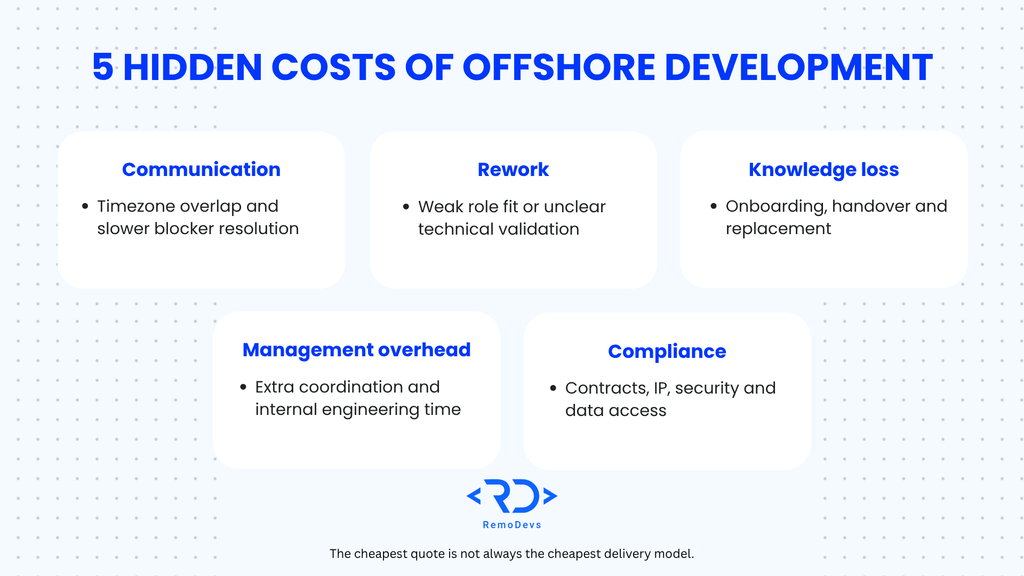
The five hidden costs of offshore development are:
- communication and timezone coordination;
- rework caused by weak role fit or screening;
- turnover, onboarding and knowledge transfer;
- internal management and coordination overhead;
- contract, IP, security and compliance work.
They are not inevitable or unique to one region. Distributed teams can work well when responsibilities, working-hour overlap, evaluation criteria, delivery ownership and contract terms are clear. Problems arise when companies compare headline rates without comparing how the work will actually be delivered.
1. Communication and timezone coordination
Timezone difference is not a measure of engineering quality. It determines when people can solve problems together.
Some work is well suited to asynchronous delivery. A defined task with clear acceptance criteria may require little live discussion. Architecture decisions, production incidents, ambiguous requirements and changes across tightly coupled systems usually benefit from more overlap. Research on globally distributed software teams has linked distance and limited availability with additional coordination challenges.
Map the actual dependencies before accepting a proposal. Check when the engineer can reach their technical lead, product owner, code reviewers and anyone responsible for access, infrastructure or incident response.
A calendar invitation is not the same as useful overlap. Look at when decisions are made and who must be present. A daily stand-up may fit both schedules while code reviews, product clarification or infrastructure support still sit outside the shared window. For work with many cross-team dependencies, those queues matter more than the nominal time difference.
Use agreed schedules rather than the supplier’s country alone. Based on the published 2026 offsets for Warsaw, New York and Los Angeles, standard 9:00–17:00 days in Warsaw and New York overlap for two hours during most of the year. They briefly overlap for three hours because the US and EU change clocks on different dates. Standard Warsaw and Los Angeles office hours do not normally overlap.
A shifted schedule can create more US overlap, but it must be agreed with the individual or provider. Calculate the real overlap for both summer and winter, then decide whether it is sufficient for blocker resolution, code review, design discussions and production support.
2. Rework caused by weak role fit or screening
Rework is often blamed on geography when the underlying problem is an unclear role or weak evaluation.
“Senior React developer” might describe someone who shapes frontend architecture or someone who delivers within an established system. The same title can also hide experience that only partly matches the product. If the client and provider use different definitions, the gap usually becomes visible after work starts.
The resulting cost extends beyond rewriting code. Internal engineers may spend more time reviewing and debugging, releases may slip, and senior employees may pause planned work to explain the product or architecture again.
Role calibration should cover the environment around the technology as well as the technology itself. An engineer may know the framework but have limited experience with the scale, reliability requirements, regulatory context or level of product ownership expected. These are not reasons to reject the person automatically. They are gaps to identify before deciding how much support the role will require.
Before comparing candidates or suppliers:
- Define what the person will own, not only the technologies they should know.
- Agree what evidence demonstrates the required seniority.
- Separate recruiter screening from technical validation.
- Assign an owner and consistent criteria for the technical assessment.
- Record what has been verified and what remains open.
A focused shortlist with clear screening context is easier to evaluate than a large CV pipeline with little evidence. RemoDevs explains the division of responsibilities in Why IT Recruitment Processes Fail: A Practical Agency Checklist and defines “sourced,” “recruiter-screened” and “technically assessed” in How RemoDevs Screens Software Engineers in Poland.
Once delivery begins, track rework separately from normal review. A requested change because the requirement evolved is not the same as correcting work that missed an agreed acceptance criterion. Keeping those categories separate makes the supplier review fairer and helps expose whether the problem sits in engineering, specification or decision-making.
3. Turnover, onboarding and knowledge transfer
When an engineer leaves, the replacement expense is only part of the cost. The team may need to transfer product knowledge, repeat access setup, redistribute work and rebuild context.
There is no defensible universal onboarding period for a software engineer. Joining a documented service with clear boundaries is different from entering a large legacy product where knowledge sits with a few people. Research on onboarding in globally distributed legacy projects found that project scale, legacy-code complexity and distance from the original knowledge sources made onboarding harder in the cases studied. It does not provide a universal timeline.
Geography is not a reliable proxy for retention either. Turnover depends on the individual, work, compensation, management, contract and expectations set during hiring.
Build a replacement scenario from your own environment. Include handover time, recruitment and interviews, setup and training, reduced capacity during ramp-up, disrupted delivery and any supplier fees. Current runbooks, architecture decisions and ownership maps can reduce the impact. The contract should also cover notice, offboarding, access revocation and knowledge transfer.
Knowledge concentration is worth checking before anyone resigns. Identify components for which only one person understands the operating history, deployment process or recurring failure modes. Then decide which knowledge needs documentation, pairing or shared ownership. This is ordinary delivery resilience, but it becomes more visible when team members work across companies and locations.
4. Internal management and coordination overhead
External engineering does not remove management work. The relevant cost is the additional effort created compared with your normal delivery process.
It may be spread across engineering, product, project management, security, procurement and finance, making it easy to miss when evaluating a provider invoice. Use an organization-specific calculation:
Monthly coordination cost = additional internal coordination hours × internal loaded hourly cost
Count only incremental work. Every engineering team needs planning, review and management, so assigning the entire existing process to an external engineer would overstate the cost.
Track extra alignment meetings, repeated clarification, added code-review or architecture support, escalations, reporting and supplier administration. Rework should be recorded separately to avoid double counting.
The measurement does not need to become a new reporting bureaucracy. A lightweight weekly record from the engineering lead and project manager is usually enough to show whether time is being spent on normal collaboration or recurring avoidable issues. Record the activity, people involved and approximate duration using the same categories throughout the review period.
Use the loaded-cost method already accepted by your finance team. During a pilot or initial delivery period, compare the result with a similar internal baseline. If the same clarifications and corrections continue after the engineer has gained context, investigate role fit, delivery design and ownership instead of treating the overhead as an unavoidable “offshore tax.”
Review the trend as well as the total. Higher coordination at the start of an engagement may reflect legitimate onboarding. A flat or rising burden later can point to unclear decision rights, missing documentation, unstable scope or a mismatch between the engineer’s autonomy and the role.
5. Contract, IP, security and compliance work
Legal and compliance work follows the engagement structure and the work performed, not simply the developer’s country. Direct employment, independent contracting, staff augmentation and project outsourcing create different responsibilities.
Before work starts, confirm:
- which entities and subcontractors are involved;
- scope, acceptance, payment, term and termination provisions;
- confidentiality and permitted use of client information;
- ownership or licensing of deliverables, background IP and third-party components;
- data locations, access, subprocessors and international transfers;
- security controls, incident handling, audit rights and offboarding;
- applicable law and dispute-resolution terms.
Payment alone should not be treated as proof of IP ownership. WIPO’s guidance on software development agreements recommends distinguishing commissioned IP, background IP and the rights assigned or licensed to the customer.
Poland is an EU Member State, but using a Polish engineer does not make an engagement automatically GDPR-compliant. If a supplier processes personal data for the client, a written controller–processor arrangement may be required under Article 28. The EDPB’s controller and processor guidelines explain the relevant responsibilities. Transfers of personal data to a third country may require additional review under GDPR Chapter V; the EDPB provides guidance on identifying international transfers.
A provider’s location also does not satisfy client-specific security, regulated-data or audit obligations. Review the actual access model, controls and contract with qualified legal and security advisers where necessary.
The review should follow access, not job title. An engineer working only with synthetic test data creates a different risk profile from someone who can access production systems or customer records. Confirm least-privilege access, device and account requirements, incident contacts, evidence the client needs from the supplier and what happens to repositories, credentials and data when the engagement ends.
This is general commercial information, not legal advice.
How to calculate the real cost of an external engineering model
Start with the quote, then add the incremental costs created by the engagement.
| Cost category | What to measure |
|---|---|
| External engineering cost | Provider or contractor invoice for the expected capacity and term |
| Internal coordination | Additional engineering, product and project-management hours |
| Rework | Time spent correcting, rebuilding, retesting or clarifying work |
| Onboarding | Setup, training, documentation and mentoring time |
| Replacement | Search, interviews, handover and lost context if someone leaves |
| Tooling and administration | Licences, equipment, access, procurement and invoice handling outside the quote |
| Legal, security and compliance | Contract review, data-protection work, supplier checks and security assurance |
Effective delivery cost = quoted external cost + incremental coordination + rework + onboarding and replacement + tooling and administration + legal, security and compliance work
Normalize competing proposals before using the formula. Compare the same role, autonomy, capacity, delivery period, currency and tax treatment. Check assumptions about leave, holidays, overtime, equipment, travel, notice, replacements and rate changes. Provider responsibilities and exclusions should also match.
Choose a review period long enough to include onboarding and ordinary delivery. Capture the quoted cost and internal effort under the same categories for each option. If exact time data is unavailable, use consistent estimates from the people doing the work and state the assumptions. The result will still be more defensible than applying a universal markup to the supplier’s rate.
Most importantly, do not compare an employee’s gross salary, contractor invoice, staff augmentation rate and managed outsourcing quote as though they buy the same thing. They represent different responsibilities and cost structures. How Much Does IT Staff Augmentation Cost in Poland in 2026? explains these distinctions in more detail.
What changes when hiring engineers in Poland?
Poland can be a practical market for distributed engineering teams because of identifiable structural factors, not because location guarantees candidate quality.
Poland has been an EU Member State since 2004 and uses Central European Time. This provides straightforward working-hour overlap with many European teams. Standard overlap with US Eastern Time is more limited but can be extended through agreed schedules. US Pacific Time requires a deliberate shift or a strongly asynchronous operating model.
“Nearshore” and “offshore” are relative terms. A German company may describe Poland as nearshore, while a US company may call the same arrangement offshore. Buyers should focus on working-hour overlap, engagement model, individual role fit, delivery ownership, data access and comparable total cost.
The available model also changes the evaluation. A permanent capability may justify direct recruitment, while a defined need for external capacity may fit staff augmentation. Neither choice determines delivery quality on its own; it determines which responsibilities and costs the client must plan for.
Location does not guarantee engineering quality, communication, retention or low management overhead. Those factors must be evaluated in the candidate, provider, contract and team design.
Choose the service model before comparing cost
Recruitment, staff augmentation and project outsourcing solve different problems.
| Model | Who engages the engineer? | Who manages day-to-day delivery? | Provider responsibility |
|---|---|---|---|
| Direct IT recruitment | The client hires the selected candidate | The client | Search, agreed screening, interview coordination and offer support |
| IT staff augmentation | The specialist joins through the provider for an agreed engagement | Typically the client | Sourcing, agreed screening, contracting or administration and engagement support |
| Project outsourcing | The vendor supplies and manages the delivery team | The vendor under the agreed scope | Delivery of a defined service, scope or outcome, subject to the contract |
A staff augmentation rate is not directly comparable with a managed-project quote. Direct recruitment likewise does not transfer payroll, employment or delivery responsibility unless a separate service expressly covers it.
How RemoDevs helps companies hire technical talent in Poland
RemoDevs supports international companies through direct IT recruitment in Poland and IT staff augmentation in Poland.
Depending on the model, RemoDevs supports role calibration, sourcing, recruiter screening, candidate presentation, interview coordination, feedback and offer support, or the contracting, administration, onboarding coordination and ongoing support of an augmented specialist. The client retains control of the hiring decision, roadmap, technical direction and day-to-day delivery.
Technical validation is defined for each search. The client normally owns product-specific engineering evaluation unless a separate assessment scope is agreed. Clearer sourcing and screening cannot remove every delivery risk, but they can reduce avoidable mismatches.
If you are evaluating a direct hire or staff augmentation specialist in Poland, talk to RemoDevs about the role and working model.
FAQ
What are the hidden costs of offshore development?
The main hidden costs are coordination, rework, onboarding and knowledge transfer, internal management, tooling and administration, and contract, IP, security or compliance work. Their size depends on the role, team dependencies, provider scope and engagement model.
How should companies compare offshore development costs?
Normalize the role, capacity, term, currency, working hours, inclusions and contract terms. Add the incremental internal effort created by each option instead of comparing rates alone.
Does a lower hourly rate mean a lower software development cost?
Not necessarily. A lower rate can produce a lower total cost, but only if coordination, rework and other expenses remain controlled. Use internal hours and project data rather than a generic multiplier.
How does timezone overlap affect distributed engineering teams?
Overlap influences how quickly teams can resolve blockers, review code, make architecture decisions and respond to incidents. Calculate it from agreed schedules and check seasonal clock changes.
Is hiring developers in Poland considered offshore or nearshore?
It depends on the client’s location. Poland is often considered nearshore by European companies and offshore by North American companies. Working-hour overlap and operating model are more useful than the label.
What should companies check before hiring external developers?
Check role ownership, evaluation criteria, technical-assessment responsibility, working hours, delivery management, provider inclusions, IP rights, data access, security requirements, notice and replacement terms.
Sources and methodology
This guide deliberately avoids generic global rate averages, universal turnover percentages, onboarding timelines and blended-cost multipliers. Such figures rarely align across role, seniority, geography and engagement model.
Timezone examples are calculations based on published Warsaw, New York and Los Angeles offsets and a stated 9:00–17:00 local workday. The EU’s seasonal clock-change rules explain why overlap should be checked across the year. Cost formulas must be populated with the buyer’s own invoices, internal cost method and project data. Legal guidance is general and may require engagement-specific review.
Visit us
Find a moment in your calendar and come to our office for a delicious coffee
Make an apointment