
Hiring software developers in Poland can give international companies access to experienced engineering talent in a convenient European time zone. The difficult part is not deciding whether Poland is worth considering. It is choosing the right hiring model, setting a realistic budget and understanding which party is responsible for employment, contracts, payroll, intellectual property and day-to-day delivery.
A recruitment agency, an Employer of Record, a staff augmentation provider and a software development company solve different problems. Treating them as interchangeable can create unclear costs and compliance gaps.
This guide explains how to hire developers in Poland in 2026, what current salary data can and cannot tell you, and how to choose between direct hire, B2B cooperation, EOR and staff augmentation.
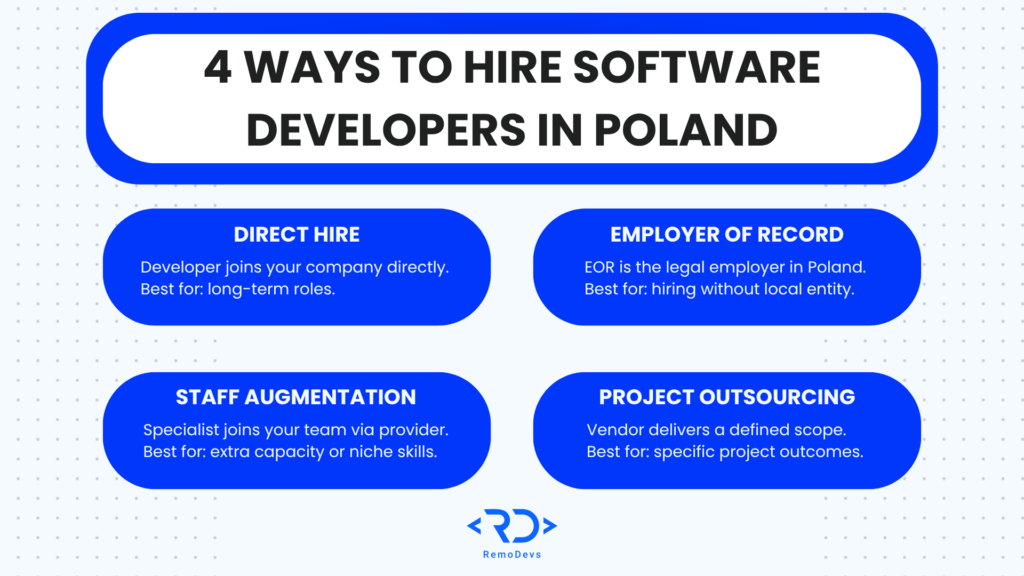
Quick answer: Use direct recruitment when you want the developer to join your company. Consider an EOR when you want an employee in Poland but do not have the required local employment setup. Use staff augmentation when you need a specialist to join your team through a provider for an agreed period. Use project outsourcing when you want an external company to own delivery of a defined project or outcome.
Why companies hire software developers in Poland
Poland has established technology communities in Warsaw, Kraków, Wrocław, Poznań, the Tricity and the Silesian metropolitan area. International employers recruit across backend, frontend, mobile, data, AI, cloud, DevOps, cybersecurity and technical leadership roles.
The practical advantages include:
- European time-zone alignment. Poland uses CET in winter and CEST in summer, enabling full working-day overlap with most European teams and partial overlap with North America.
- A multi-city talent market. Employers are not limited to one technology hub, especially when the role can be remote or hybrid.
- Experience with international products. Many candidates have worked in global product companies, consultancies, shared-service centres or distributed engineering teams.
- Several engagement models. Depending on the role and legal assessment, companies can consider direct employment, genuine independent B2B cooperation, EOR or staff augmentation.
Do not use one broad number as the size of Poland’s “developer pool.” Eurostat’s ICT specialist category includes a wider group of technology occupations and is not the same as a count of software developers available for hire. The relevant market is narrower still after filtering for stack, seniority, location, language, salary and availability.
English should also be assessed candidate by candidate. A national proficiency index cannot confirm whether a particular engineer can lead architecture discussions, write precise documentation or communicate effectively with stakeholders.
Choose the hiring model before starting the search
The phrase “hire a developer in Poland” can describe four different arrangements.
| Model | Who has the relationship with the specialist? | Who manages daily work? | What the provider normally handles | Best suited to |
|---|---|---|---|---|
| Direct hire through a recruitment agency | The candidate signs directly with the client, as an employee or a genuine independent business | The client | Sourcing, screening, candidate presentation and process coordination | Long-term roles inside the client’s organisation |
| Employer of Record | The EOR is the legal employer; the client receives the person’s services under the EOR agreement | Usually the client, within the agreed structure | Local employment contract, payroll and statutory employer administration | Employing in Poland without building the full local employment setup |
| Staff augmentation | The specialist works through the augmentation provider under the agreed contractual chain | The client controls backlog, priorities and day-to-day collaboration | Talent search, matching and the contractual or administrative scope defined in the agreement | Temporary capacity, scarce expertise or a project phase |
| Project outsourcing | The development vendor supplies and manages the delivery team | The vendor usually manages delivery | Team, delivery process and agreed project outputs | A defined project, workstream or business outcome |
The commercial label alone is not enough. Before choosing a provider, ask who signs with the individual, who pays them, who is responsible for employer obligations, how intellectual property reaches the client and what happens when the engagement ends.
Direct hire
In direct recruitment, the agency finds and screens candidates, but the selected person joins the client’s organisation directly. The client makes the final hiring decision and is responsible for the employment or contractor arrangement.
Direct hire is usually the best fit when the role is part of the long-term core team, the company wants a direct relationship with the developer and it can support the relevant legal and administrative setup.
The final contract may be:
- an employment contract, with Polish employment, payroll and social-security obligations; or
- a services agreement with a genuinely independent Polish business, commonly called a B2B contract.
Those routes should not be presented as equivalent. A recruitment agency does not automatically become the employer, payroll provider or contracting intermediary simply because it found the candidate.
Employer of Record
An EOR employs the developer locally and handles the employer-side administration covered by its service. The client generally directs the person’s work, while the EOR remains the legal employer.
This may be suitable when a company wants an employment relationship in Poland but does not have the required local setup. EOR pricing, benefits, IP provisions, termination rules and responsibility boundaries should be reviewed in the actual agreement.
An EOR is not the same service as recruitment. A recruiter can introduce a candidate to an EOR arrangement, but that does not make the recruiter the legal employer.
Independent B2B cooperation
Many Polish technology professionals operate registered businesses and invoice clients for services. B2B can be a valid option when the relationship is genuinely business-to-business and the working arrangement reflects that independence.
It is not a shortcut that automatically removes every employment, tax or IP issue. The Polish State Labour Inspection explains that a civil-law label is not decisive when the work has the features of employment, including personal, repetitive work under the employer’s direction at a specified place and time. Companies should have Polish legal and tax advisers review the real working model, not only the agreement’s title.
B2B is common, but it should not be described as the only or universally dominant route. In Bulldogjob’s 2025 IT community survey, 38.5% of respondents reported B2B cooperation and 53.8% reported an employment contract. This is survey evidence from one sample, not a census, but it shows why candidate preferences must be checked rather than assumed.
Staff augmentation
With staff augmentation, a specialist joins the client’s existing team through a provider for an agreed period. The client retains responsibility for priorities, backlog and day-to-day work. This differs from project outsourcing, where a vendor usually manages delivery and accepts responsibility for an agreed result.
Staff augmentation can work well when a team needs senior expertise quickly, has a temporary capacity gap or lacks a specific skill such as data engineering, AI, security, Java, Python or solution architecture.
The provider agreement should state exactly what “administration” includes. Do not assume that the phrase covers payroll, one consolidated invoice, benefits, IP transfer, equipment or every compliance obligation unless these items are expressly included.
How much does it cost to hire a developer in Poland in 2026?
There is no reliable single “Polish developer salary.” Compensation changes with seniority, technology, product complexity, English and stakeholder responsibilities, work mode, contract type and the urgency of the search.
Just Join IT’s 2026 salary report analysed more than 110,000 job advertisements published during 2025. For each advert, the researchers calculated the midpoint of the published salary range and then reported the median of those midpoints for each technology and seniority level. This makes the data useful for initial budget calibration, but it is not a forecast of 2026 pay or a record of what every candidate actually earns.
The report gives the following monthly benchmarks for four widely used development technologies. In each cell, the first figure is gross monthly salary on an employment contract and the second is the monthly B2B invoice value excluding VAT.
| Technology | Junior: employment / B2B | Mid-level: employment / B2B | Senior: employment / B2B |
| Java | PLN 8,500 / PLN 10,500 | PLN 16,100 / PLN 20,622 | PLN 23,250 / PLN 25,200 |
| JavaScript | PLN 9,500 / PLN 7,948 | PLN 15,500 / PLN 17,640 | PLN 21,953 / PLN 23,520 |
| Python | PLN 8,750 / PLN 9,750 | PLN 17,000 / PLN 19,740 | PLN 23,488 / PLN 25,500 |
| .NET | PLN 8,250 / PLN 9,000 | PLN 15,080 / PLN 18,900 | PLN 20,500 / PLN 23,520 |
These figures are medians of advertised range midpoints, not universal market rates. A “Python developer” may work in backend engineering, data or AI, while two senior engineers in the same language can have very different architecture, cloud and leadership responsibilities. Use the table to set an initial range, then validate it against the specific role and current candidate conversations.
Employment salary and B2B invoice value are not directly comparable. A B2B figure is not take-home pay: the contractor still covers their own tax, social-security contributions and business costs. Likewise, neither column represents the client’s full cost of employment, an EOR fee or a staff augmentation rate.
For a more detailed breakdown, see RemoDevs’ 2026 Polish IT market report.
Calculate total cost, not only salary
A realistic hiring budget may include:
- gross salary or contractor invoice;
- employer social-security and payroll costs for employees;
- recruitment fee, EOR fee or staff augmentation margin;
- equipment, software, benefits and onboarding;
- currency conversion and international payment costs;
- internal interview and management time;
- legal, tax and contract review; and
- replacement or notice costs if the hire does not work out.
Avoid universal claims that Poland is always 30%, 40% or 50% cheaper than another market. The comparison changes materially with role, city, seniority, exchange rate, benefits and engagement model. Build the business case from a named role and a documented cost scenario.
How to hire software developers in Poland step by step
1. Define the work before the technology list
Start with the outcomes the person will own during the first six to twelve months. Specify the system scale, architecture, product stage, team composition, decision-making responsibility and expected stakeholder contact.
A requirement such as “Senior Python Developer” is too broad. A senior engineer building data pipelines on AWS, a backend developer maintaining Django services and a staff engineer redesigning a distributed platform require different search strategies and salary ranges.
2. Choose the engagement model
Decide whether the person should join your company directly, work as a genuine independent contractor, be employed through an EOR or join through staff augmentation. Confirm the legal and tax implications before presenting the opportunity to candidates.
Candidates should receive a consistent explanation of:
- who they will sign with;
- contract type;
- compensation currency and payment schedule;
- remote, hybrid or office expectations;
- benefits or paid time off, if applicable;
- expected working hours and time-zone overlap; and
- notice or termination terms.
3. Calibrate the role against the market
Compare the brief with current job-ad data and recent candidate conversations. If the budget, required seniority and technology combination do not align, adjust the scope before launching the search.
For hard-to-fill roles, decide which requirements are essential and which can be learned after joining. Requiring several rare technologies, industry experience, a narrow city and immediate availability can reduce the viable market to almost zero.
4. Source beyond active applicants
Use a mix of Polish technology job boards, LinkedIn, referrals, specialist communities and direct sourcing. Senior developers are often passive candidates, so the initial message should explain the product, technical problem, team, contract model, salary range and interview process.
Publishing a transparent salary range and work model helps candidates self-select and reduces wasted interviews.
5. Separate recruiter screening from technical assessment
A recruiter screen should verify relevant experience, motivation, communication, availability, compensation expectations and practical fit with the role. It should not be presented as a full technical validation unless the recruiter or assessment team actually performed one.
Technical evaluation can combine:
- a structured discussion of relevant projects and decisions;
- architecture or debugging scenarios based on the real role;
- a proportionate coding exercise, live or asynchronous;
- code-review discussion; and
- a conversation with the future manager or engineering peers.
Evaluate evidence that predicts the job. A long generic take-home task can drive strong candidates away without testing the skills the role needs.
6. Keep the interview process focused
Agree on evaluation criteria before interviews begin. Use the same core questions and scorecard for every candidate, collect feedback quickly and assign one person to make the final decision.
A typical process might include recruiter screening, technical interview, team or leadership conversation and references or an offer discussion. Add stages only when each one answers a different hiring question.
7. Prepare the offer and contract in parallel
Before the final interview, confirm who can approve the compensation, which contract template will be used and whether legal review is complete. Delays between verbal acceptance and a written offer give competing employers time to close the candidate.
8. Plan onboarding before the start date
Arrange equipment, access, security training, documentation, a first-week schedule and a named onboarding owner. Define 30-, 60- and 90-day expectations around outcomes, not simply activity.
Legal and operational checklist
This section is general information, not legal or tax advice. The correct setup depends on the countries involved, the worker’s status and the actual way the relationship operates.
Employment and payroll
When hiring an employee in another EU country, the employer generally needs to register locally and follow the relevant labour, tax and social-security rules. The EU’s guidance on registering as an employer in another country provides a useful starting point.
Confirm whether the company will register directly, use an existing Polish entity or engage an EOR. A recruitment agreement alone does not solve employer registration or payroll.
Worker classification
Review how the relationship works in practice: direction and control, fixed place and hours, personal and continuous service, business risk, substitution and independence. A B2B heading does not override facts that indicate employment.
Intellectual property
Do not assume that paying an invoice automatically transfers all rights to code, documentation, designs or other work product. The Polish Patent Office’s guide to intellectual property for entrepreneurs distinguishes moral and economic rights and explains that economic rights can be transferred.
Have qualified counsel verify:
- whether rights are assigned or licensed;
- which fields of exploitation and territories are covered;
- when the transfer takes effect;
- how pre-existing materials and open-source components are treated;
- whether the full contractual chain reaches the end client; and
- what obligations continue after termination.
Data protection and security
Define the lawful handling of candidate and worker data, retention periods, access controls and any transfers outside the European Economic Area. For production access, include confidentiality, security policies, least-privilege permissions and an offboarding process.
Tax and permanent-establishment risk
Ask tax advisers to review corporate tax, VAT, withholding, permanent-establishment and contractor tax-residency questions. The outcome can differ based on the client’s country, contract, authority granted to the developer and how the work is organised.
Notice and availability
For Polish employment contracts, statutory notice can be two weeks, one month or three months depending on tenure, as summarised on the Polish government’s employment terms page. B2B notice is governed by the services agreement and should not be described as automatically one month.
Ask candidates for both their contractual notice and realistic start date early in the process.
How RemoDevs supports hiring in Poland
Based on its current public service pages, RemoDevs supports two distinct routes.
Direct recruitment
For companies that want to hire a candidate directly, RemoDevs provides IT recruitment in Poland. The published process covers role and market calibration, active sourcing, recruiter screening, candidate presentation, interview coordination and offer support. The client decides whom to interview and hire.
RemoDevs states that it aims to present the first qualified candidates within five working days for most searches. This should be understood as a target for candidate presentation, not a guarantee of the final hire or start date. Role complexity, client interview speed and candidate notice periods still affect the full timeline.
Success-fee recruitment is also available, with the detailed fee and guarantee terms agreed for the search.
Staff augmentation
For companies that need a specialist to join an existing team for an agreed period, RemoDevs offers IT staff augmentation in Poland. Its published focus includes senior Data, AI and Security specialists, solution architects and selected senior Java and Python engineers.
The public process includes requirement calibration, sourcing, technical, business and team-fit screening, candidate presentation, contractual and administrative support, onboarding coordination, ongoing communication and replacement support. The client manages the specialist’s backlog, priorities and daily work.
The exact contract, payment flow, invoice structure, IP provisions, administration and replacement terms should be confirmed in the proposal and agreement for each engagement. RemoDevs should not be presented as an EOR unless that role is separately confirmed and documented.
Questions to ask any Polish hiring partner
Before selecting a recruiter, EOR or staff augmentation provider, ask:
- Which service model are you proposing, and why does it fit this role?
- Who signs the employment or services agreement with the developer?
- Who pays the person and handles payroll, taxes or contractor invoices?
- What screening has already happened, and what still belongs to our team?
- How do you validate technical ability for this specific role?
- How will intellectual property reach our company?
- What exactly is included in the quoted fee or monthly rate?
- What are the replacement, notice and termination terms?
- Which timeline is a target, and which part is contractually guaranteed?
- Can you provide relevant, verifiable client references or case studies?
Clear answers make it much easier to compare proposals that may otherwise use similar marketing language for very different services.
Frequently asked questions
Can a foreign company hire a software developer in Poland?
Yes, but the correct route depends on the relationship. A company may hire through its Polish entity, register as a foreign employer where applicable, use an EOR, engage a genuinely independent Polish business or use staff augmentation. Legal and tax advisers should confirm the setup for the specific countries and working arrangement.
Do I need a Polish legal entity?
Not in every model. An EOR may employ the person locally, and genuine B2B cooperation or staff augmentation may not require the client to establish a Polish entity. Direct employment can still create local registration, payroll, social-security and labour-law obligations even when the company has no subsidiary.
Is a B2B contract the same as staff augmentation?
No. B2B describes a services relationship between businesses. Staff augmentation describes how an external specialist joins and extends a client’s team. A staff augmentation engagement may use B2B agreements somewhere in its contractual chain, but the two terms are not interchangeable.
Is an EOR the same as a recruitment agency?
No. A recruitment agency finds and screens candidates for the client to hire. An EOR becomes the local legal employer. One provider may coordinate with the other, but their responsibilities remain different.
How quickly can I hire a developer in Poland?
It depends on role scarcity, salary, interview speed, contract readiness and notice period. RemoDevs says it aims to present qualified candidates within five working days for most direct searches, but candidate presentation is not the same as completing a hire or reaching the start date.
Does RemoDevs handle payroll, IP transfer and one monthly invoice?
RemoDevs’ current public pages confirm direct recruitment and a separate staff augmentation service with agreed contractual and administrative support. They do not establish one universal payroll, EOR, IP-transfer or invoice promise for every engagement. Confirm each responsibility in the proposal and signed agreement.
Build the right hiring process for Poland
Poland can be an excellent market for software engineering, data, AI, cloud, security and technical leadership roles. Results depend on a clear role, realistic compensation, fast decision-making and the right engagement model.
If the person should join your company directly, explore IT recruitment in Poland. If you need a senior specialist to extend an existing team for an agreed period, review IT staff augmentation in Poland.
Discuss your hiring needs with RemoDevs and clarify the role, contract model, timeline and responsibilities before the search begins.
Visit us
Find a moment in your calendar and come to our office for a delicious coffee
Make an apointment