
Scaling cloud infrastructure requires engineers who can do more than configure standard services or collect certifications.
The strongest candidates understand distributed systems, production reliability, infrastructure security, automation, and the trade-offs behind architectural decisions. They know not only how to deploy infrastructure, but also how to operate it safely under real production conditions.
For CTOs and engineering leaders expanding their infrastructure capabilities, Poland offers a large and established technology market with cloud, DevOps, platform, Kubernetes, and reliability engineers working for both local and international organizations.
However, finding the right candidate requires more than searching for AWS, Kubernetes, or Terraform on a CV. Employers need a structured approach to technical screening, compensation, contracting models, and candidate evaluation.
This guide explains what to look for when hiring cloud infrastructure and Kubernetes engineers in Poland.
Why Hire Cloud Infrastructure Engineers in Poland?
Poland has a mature technology sector and a substantial population of engineers experienced in cloud platforms, automation, distributed systems, and international software delivery.
The country offers several practical advantages for companies building remote or distributed engineering teams.
Time-Zone Compatibility
Poland operates in Central European Time and Central European Summer Time.
This provides full working-day overlap with teams in Germany, Austria, Switzerland, Scandinavia, and most other European markets. Poland is also one hour ahead of the United Kingdom.
For companies based in North America, Polish engineers can provide limited but useful morning overlap with teams on the US East Coast. This can be sufficient for:
- Daily stand-ups
- Sprint planning
- Technical handovers
- Architecture discussions
- Incident coordination
- Cross-team alignment
Companies working across several time zones should still define expectations around availability, on-call responsibilities, and meeting schedules before starting the recruitment process.
International Project Experience
Many Polish infrastructure engineers have worked for global technology companies, consultancies, financial institutions, SaaS businesses, and distributed product teams.
Depending on their previous employers and industries, candidates may also have experience with environments subject to:
- GDPR
- ISO 27001
- SOC 2
- PCI DSS
- Internal enterprise security controls
- Regulated financial or healthcare requirements
This experience should always be verified individually.
Working for a European or international company does not automatically mean that a candidate personally owned security, audit, or compliance responsibilities.
English Proficiency
Poland ranked 15th globally in the 2025 EF English Proficiency Index and was placed in the “very high proficiency” category.
This provides useful market-level context, but it should not replace individual assessment.
Employers should still verify whether candidates can:
- Explain architectural decisions clearly
- Communicate during production incidents
- Challenge assumptions constructively
- Document infrastructure changes
- Present technical risks to non-technical stakeholders
- Work effectively in international teams
For infrastructure and reliability roles, the ability to communicate clearly during high-pressure situations is particularly important.
Remote and Distributed Work Experience
A large number of Polish IT professionals have experience working remotely with international teams across several locations and time zones.
However, remote-work experience alone does not guarantee strong collaboration.
Communication style, autonomy, operational ownership, documentation habits, and remote-work maturity should still be evaluated during the recruitment process.
What Skills Should You Look For?
A modern cloud infrastructure engineer is not simply a system administrator working with newer tools.
The strongest candidates understand how infrastructure, application delivery, security, observability, and production reliability interact.
The exact skill set will depend on your architecture, but the following areas provide a useful evaluation framework.
Cloud Infrastructure Engineer Skills at a Glance
| Area | What to Evaluate | Example Technologies |
| Kubernetes | Production operations, upgrades, scaling, networking, troubleshooting, security and resource management | EKS, GKE, AKS, Helm, Kustomize |
| Cloud architecture | High availability, IAM, networking, disaster recovery, cost management and environment design | AWS, Google Cloud, Microsoft Azure |
| Infrastructure as Code | State management, module design, testing, refactoring, imports and drift control | Terraform, Terragrunt, Pulumi, CloudFormation |
| CI/CD and GitOps | Deployment safety, rollback strategies, release automation and configuration synchronization | GitHub Actions, GitLab CI, Jenkins, Argo CD, Flux |
| Security | Least privilege, secrets management, scanning, policy enforcement and auditability | Vault, AWS Secrets Manager, Azure Key Vault, OPA |
| Observability | Metrics, logs, traces, dashboards, alerting and incident investigation | Prometheus, Grafana, Datadog, OpenTelemetry |
| Reliability | Capacity planning, failure recovery, runbooks, resilience and operational automation | SLOs, error budgets, autoscaling, disaster recovery |
| Communication | Technical explanations, documentation, incident updates and stakeholder alignment | Architecture reviews, runbooks, post-incident reports |
The presence of these tools on a CV should not be treated as proof of senior-level expertise.
The evaluation should focus on how the candidate used them, what scale they supported, what problems they solved, and how much responsibility they personally carried.
Kubernetes and Container Orchestration
Certifications such as CKA or CKS can demonstrate theoretical knowledge, but they should not be treated as proof of senior-level production experience.
Depending on your architecture, relevant Kubernetes experience may include:
- Operating production Kubernetes clusters
- Managing multi-cluster or multi-region environments
- Supporting multi-tenant platforms
- Configuring ingress, networking, and service discovery
- Performing Kubernetes upgrades
- Troubleshooting scheduling and resource issues
- Managing stateful applications
- Implementing autoscaling
- Reducing Kubernetes-related cloud costs
- Developing or maintaining custom controllers
- Implementing cluster security and policy controls
Not every role requires experience in all of these areas.
A company operating one managed Kubernetes cluster does not necessarily need an engineer who has built custom controllers in Go. Likewise, a company running a complex platform across several regions may need experience far beyond basic deployment and maintenance.
The interview should reflect the environment the candidate will actually support.
How to Evaluate Kubernetes Experience
A useful technical discussion should go beyond asking whether someone has used Kubernetes.
Instead, ask how they would investigate realistic production problems, such as:
- A pod repeatedly entering CrashLoopBackOff
- Rising application latency after a deployment
- Nodes experiencing memory pressure
- Uneven pod distribution across availability zones
- Unexpected increases in cloud spending
- A stateful workload failing during rescheduling
- A cluster upgrade causing application instability
- A deployment succeeding technically but failing health checks
- A service becoming unavailable despite healthy pods
The goal is to understand how the candidate reasons, not whether they have memorized commands.
Strong candidates should be able to explain:
- What information they would collect first
- Which assumptions they would test
- How they would limit the impact of troubleshooting
- When they would roll back a change
- How they would communicate during the incident
- What improvements they would introduce afterwards
Infrastructure as Code and Automation
Manual infrastructure configuration does not scale reliably and should be minimized in production environments.
Infrastructure should be:
- Version-controlled
- Reviewable
- Auditable
- Reproducible
- Testable
- Consistent across environments
Common technologies include:
- Terraform
- Terragrunt
- Pulumi
- AWS CloudFormation
- Ansible
Strong candidates should understand more than basic resource creation.
Relevant areas include:
- Remote state management
- State locking
- Module design
- Environment separation
- Secrets handling
- Importing existing infrastructure
- Refactoring without unnecessary resource replacement
- Policy checks
- Automated testing
- Code review practices
- Drift detection
- Dependency management
- Recovery from failed infrastructure changes
A senior candidate should also be able to explain how they prevent infrastructure changes from causing unexpected downtime.
Useful interview questions include:
- How do you manage Terraform state across multiple teams?
- How do you refactor infrastructure without recreating production resources?
- How do you test Infrastructure as Code before deployment?
- How do you handle emergency manual changes?
- How do you detect and resolve infrastructure drift?
- How do you organize shared modules without creating unnecessary dependencies?
Cloud Platform Expertise
Candidates should have practical experience with the cloud provider used by your organization.
Experience should be evaluated through architectural and operational decisions, not only through a list of services.
AWS
Relevant areas may include:
- EKS
- IAM
- VPC design
- Transit Gateway
- Route 53
- Elastic Load Balancing
- CloudWatch
- RDS
- S3
- AWS Organizations
- Cost management
- Backup and disaster recovery
Google Cloud Platform
Relevant areas may include:
- GKE
- IAM
- VPC networking
- Cloud Load Balancing
- Cloud Monitoring
- Cloud SQL
- Identity-Aware Proxy
- Organization policies
- Workload Identity
- Disaster recovery
Microsoft Azure
Relevant areas may include:
- AKS
- Microsoft Entra ID
- Virtual Networks
- Azure Monitor
- Azure Key Vault
- Application Gateway
- Azure Policy
- Azure SQL
- Azure Landing Zones
- Backup and recovery
A strong candidate should be able to explain why a particular design was chosen, what alternatives were considered, and what risks or limitations were accepted.
CI/CD, GitOps, and Security
Cloud infrastructure engineers often work closely with platform, security, and application teams.
Relevant experience may include:
- GitHub Actions
- GitLab CI
- Jenkins
- Azure DevOps
- Argo CD
- Flux
- Helm
- Kustomize
A qualified candidate should be able to explain how deployment safety and security controls were implemented in the environments they supported.
This may include:
- Image scanning
- Dependency scanning
- Secret rotation
- HashiCorp Vault
- AWS Secrets Manager
- Azure Key Vault
- Workload Identity
- Least-privilege IAM policies
- Admission policies
- Network policies
- Audit logging
- Infrastructure policy checks
- Rollback strategies
- Progressive delivery
- Environment promotion rules
The candidate does not need to have personally owned every security function.
What matters is whether they understand how security fits into the infrastructure and delivery lifecycle and how responsibilities were divided between infrastructure, platform, security, and application teams.
Observability and Incident Response
Infrastructure engineers should be able to identify, diagnose, and prevent production problems.
Common tools include:
- Prometheus
- Grafana
- Datadog
- OpenTelemetry
- Elasticsearch
- Loki
- Cloud-native monitoring platforms
Strong candidates should understand:
- Metrics, logs, and traces
- Alert quality
- Service Level Indicators
- Service Level Objectives
- Error budgets
- Incident escalation
- Root cause analysis
- Capacity planning
- Runbooks
- Recovery procedures
- Post-incident improvements
During an interview, ask candidates to describe a real production incident.
Useful follow-up questions include:
- What was the first signal that something was wrong?
- How did you narrow down the cause?
- What assumptions turned out to be incorrect?
- What did you personally do?
- How did you communicate with the team?
- What changed after the incident?
- How did you reduce the chance of recurrence?
- Which monitoring signal was missing?
- What would you do differently today?
Strong answers should include context, evidence, trade-offs, personal responsibility, and lessons learned.
Soft Skills and Operational Ownership
Technical expertise is not enough if a candidate cannot communicate infrastructure risks or coordinate changes with other teams.
Clear Communication
Candidates should be able to explain complex technical decisions to:
- Software engineers
- Product managers
- Security teams
- Engineering managers
- Business stakeholders
They should also be able to adapt the level of detail to the audience.
An engineering team may need a detailed explanation of cluster networking, while a business stakeholder may only need to understand risk, impact, and expected recovery time.
Operational Ownership
Look for candidates who take responsibility for understanding how systems behave in production.
This does not mean expecting one person to be available at all times.
It means evaluating whether they:
- Investigate recurring issues
- Improve monitoring
- Document operational knowledge
- Reduce manual work
- Identify risks before they become incidents
- Follow through on reliability improvements
- Escalate problems appropriately
- Communicate uncertainty clearly
Analytical Problem-Solving
Infrastructure work often involves incomplete information.
Strong candidates should approach incidents methodically by:
- Collecting evidence
- Prioritizing likely causes
- Testing assumptions
- Limiting unnecessary changes
- Avoiding random troubleshooting
- Communicating clearly during uncertainty
- Documenting conclusions
Salary Expectations in Poland
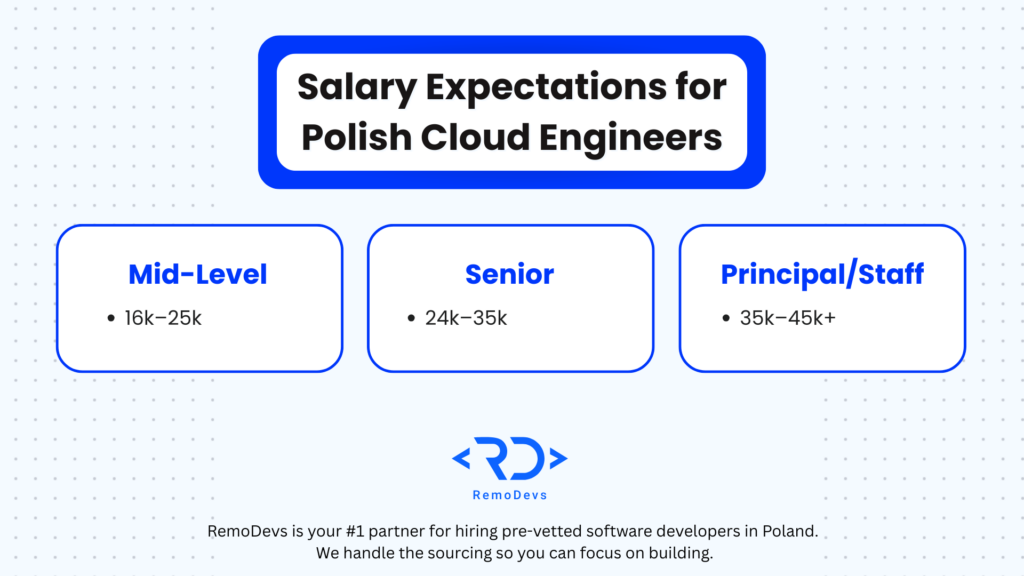
Compensation depends on:
- Technical specialization
- Project complexity
- On-call expectations
- Industry
- Contract length
- Management responsibilities
- English proficiency
- Required time-zone overlap
- Level of production ownership
- Direct cooperation with international clients
The ranges below should be treated as practical budgeting guidance rather than universal market medians.
Indicative Monthly B2B Ranges
| Seniority | Typical Scope | Indicative Monthly Invoice Value |
| Mid-Level Cloud or DevOps Engineer | Maintains cloud environments, CI/CD pipelines and Infrastructure as Code with support from senior team members | PLN 16,000–25,000 |
| Senior Cloud or Kubernetes Engineer | Owns production infrastructure, Kubernetes operations, architecture decisions and incident response | PLN 24,000–35,000 |
| Principal, Staff, SRE or Cloud Architect | Leads architecture, reliability strategy, platform engineering or complex multi-region environments | PLN 35,000–45,000+ |
These figures generally refer to monthly invoice value excluding VAT and before the contractor’s personal taxes and social-security contributions.
The upper end of the market typically applies to candidates with experience in areas such as:
- Large-scale distributed systems
- Multi-region architecture
- Advanced Kubernetes operations
- Platform engineering
- Security-sensitive environments
- Staff-level technical leadership
- SRE and reliability engineering
- Custom Kubernetes controllers
- Significant on-call responsibility
- Complex cloud migrations
- Regulated industries
Actual expectations may vary substantially between candidates.
Companies should treat salary ranges as one part of the discussion rather than the only measure of seniority.
A highly paid candidate is not automatically the right technical fit, and a candidate below the upper range may still have exactly the experience the company needs.
B2B Contracts and Employment Contracts in Poland
Two common hiring models in Poland are business-to-business cooperation and employment contracts.
Both are widely used, but they create different legal, tax, and operational relationships.
B2B Contract vs. Employment Contract
| Area | B2B Contract | Employment Contract |
| Legal relationship | Agreement between two independent businesses | Traditional employer-employee relationship |
| Payment | Contractor submits a monthly invoice | Employee receives salary through payroll |
| Working model | Usually offers greater contractual flexibility | Subject to Polish labor-law requirements |
| Paid leave | Depends on the negotiated agreement | Statutory paid annual leave |
| Sick leave | Depends on insurance and contract terms | Covered under employment and social-security rules |
| Working time | Usually agreed contractually | Regulated under Polish labor law |
| Taxes and contributions | Managed primarily by the contractor | Calculated and paid through employer payroll |
| Equipment and benefits | Defined individually in the contract | Often provided as part of employment |
| Common use | Frequently used by experienced IT contractors and international clients | Used for permanent roles requiring traditional employment protections |
| Main consideration | The relationship must genuinely reflect independent business cooperation | Creates greater employer obligations and employee protections |
B2B Cooperation
Under a B2B arrangement, the engineer operates through their own registered business and invoices the client for services.
This model is widely used among experienced Polish IT professionals, particularly when working with international companies.
Potential advantages include:
- Contractual flexibility
- Straightforward monthly invoicing
- Easier cooperation with foreign clients
- Potential tax efficiency for the contractor
- Flexible project-based cooperation
However, the agreement must reflect the actual working relationship.
A B2B label alone does not automatically make the cooperation independent.
Employment Contract
An employment contract, commonly referred to as UoP, establishes a traditional employer-employee relationship.
It includes protections and obligations under Polish labor law, such as:
- Paid annual leave
- Sick leave
- Notice periods
- Employer social-security contributions
- Working-time regulations
- Employee protections
- Payroll obligations
Contracting Considerations
The appropriate model depends on factors such as:
- Degree of independence
- Control over working hours
- Exclusivity
- Reporting structure
- Equipment ownership
- Intellectual-property transfer
- Benefits
- Long-term integration into the organization
- Operational risk
- Method of supervision
The final contract structure should be reviewed by qualified legal, tax, and payroll advisers.
This is particularly important where the cooperation may resemble employment or create intellectual-property, tax, payroll, or permanent-establishment concerns.
A recruitment partner can assist with market context and process coordination, but should not replace professional legal or tax advice.
Common Challenges When Hiring in Poland
Technical Screening
Cloud and infrastructure CVs often contain long lists of technologies without explaining the candidate’s actual responsibilities.
A candidate may have used Kubernetes without:
- Designing the platform
- Handling production incidents
- Performing upgrades
- Managing security
- Owning reliability
- Making architectural decisions
- Supporting stateful workloads
- Managing cost or capacity
Screening should focus on:
- Scope
- Ownership
- Production scale
- Decision-making
- Measurable outcomes
- Lessons learned
Candidate Availability
Experienced infrastructure engineers are often employed and may have notice periods or existing project commitments.
Highly specialized searches can also take longer because the relevant candidate pool is smaller.
Companies should establish early:
- Expected start date
- Notice period
- Availability
- On-call expectations
- Working hours
- Time-zone overlap
- Contract duration
Contract and Payroll Coordination
International companies may need support coordinating:
- Contract review
- Payroll or invoicing
- Benefits
- Equipment
- Intellectual-property clauses
- Local employment requirements
- Contractor administration
- Insurance
- Data protection obligations
Competition
Strong candidates often participate in several recruitment processes at the same time.
A slow or unclear process increases the risk of losing them.
Companies should aim to provide:
- Clear responsibilities
- Transparent salary ranges
- A realistic interview process
- Fast feedback
- Direct access to technical decision-makers
- A clear explanation of the architecture
- Honest information about current infrastructure challenges
How RemoDevs Supports Infrastructure Hiring
At RemoDevs, we help CTOs, VPs of Engineering, and technical hiring teams identify cloud, DevOps, platform, Kubernetes, and infrastructure professionals whose experience matches the actual engineering problem.
Our process focuses on more than keyword matching.
Technical Stack Alignment
We assess whether candidates have relevant production experience with the client’s:
- Cloud platform
- Kubernetes environment
- Infrastructure as Code tooling
- CI/CD systems
- Observability stack
- Security requirements
- Reliability expectations
Responsibility Verification
We examine what the candidate personally designed, implemented, maintained, and improved.
This helps distinguish between someone who worked near an infrastructure platform and someone who actually owned meaningful parts of it.
Scenario-Based Screening
Candidates can be evaluated through practical discussions covering topics such as:
- Zero-downtime deployment strategies
- Stateful Kubernetes workloads
- Infrastructure failures
- Cluster scaling
- Incident response
- Observability design
- Disaster recovery
- Cost optimization
- Infrastructure security
- Terraform state management
Communication Assessment
We evaluate whether candidates can:
- Explain technical decisions clearly
- Communicate during incidents
- Work with international teams
- Challenge assumptions constructively
- Document their work
- Adapt explanations to different audiences
Recruitment Models
Through success-fee recruitment, we source and screen candidates for direct hiring by the client.
The recruitment fee becomes payable after a successful hire under the agreed terms.
Where staff augmentation is more appropriate, we can also support contractor engagement and coordinate related administration within the scope of the agreed service.
For roles that closely match our existing candidate network, initial profiles may be available within several business days.
More specialized searches may require additional sourcing time.
Questions to Ask During the Interview
A strong infrastructure interview should test reasoning, production experience, and ownership.
Useful questions include:
- Describe the most serious infrastructure incident you have handled. What did you personally do?
- How would you investigate a Kubernetes workload that repeatedly restarts without a clear application error?
- How do you approach Terraform state management across multiple teams or environments?
- What controls would you introduce before allowing infrastructure changes into production?
- How have you reduced cloud costs without compromising reliability?
- How would you design observability for a new distributed service?
- What is your approach to secrets management and IAM permissions?
- How do you prepare for Kubernetes upgrades?
- How do you determine whether an alert is useful or simply creates noise?
- What infrastructure decision would you change if you could revisit one of your previous projects?
- How do you handle emergency manual changes made directly in production?
- How would you design a rollback strategy for infrastructure and application deployments?
The best answers should include:
- Context
- Trade-offs
- Personal responsibility
- Evidence
- Results
- Lessons learned
Conclusion
Hiring a cloud infrastructure or Kubernetes engineer in Poland can provide access to experienced professionals with backgrounds in cloud platforms, automation, distributed systems, and international engineering environments.
However, successful hiring depends on clearly defining the problem the engineer needs to solve.
Companies should evaluate:
- Production ownership
- Technical depth
- Incident experience
- Security awareness
- Communication
- Architectural judgment
- Contract expectations
- Ability to work across teams
Job titles and certifications can provide useful initial signals, but they should never replace detailed technical evaluation.
RemoDevs helps companies source and assess cloud, DevOps, platform, Kubernetes, and infrastructure engineers in Poland through structured screening and success-fee recruitment.
Schedule a consultation with RemoDevs to discuss the infrastructure expertise your organization needs.
Frequently Asked Questions
What is the difference between a Polish B2B contract and an employment contract?
A B2B contract is an agreement between two businesses. The engineer operates through their own registered company and invoices the client for services.
An employment contract creates a traditional employer-employee relationship governed by Polish labor law and includes statutory employment rights and benefits.
The appropriate model depends on the structure of the cooperation and should be reviewed by qualified advisers.
How quickly can RemoDevs find a senior cloud engineer?
For roles that match our existing candidate network, initial profiles may be available within several business days.
More specialized requirements, such as niche cloud platforms, advanced Kubernetes engineering, or Staff-level architecture experience, may require additional sourcing time.
Are Polish cloud engineers fluent in English?
Many Polish IT professionals work in English on international projects, and Poland ranks highly in global English-proficiency assessments.
However, English ability varies between candidates.
RemoDevs evaluates each person’s ability to discuss technical decisions, collaborate with international teams, and explain complex infrastructure topics clearly.
Are certifications such as CKA or CKS necessary?
Certifications can provide evidence of theoretical knowledge, but they are not a substitute for production experience.
Employers should prioritize candidates who can explain how they have operated, secured, upgraded, scaled, and troubleshot real Kubernetes environments.
How much does a senior Kubernetes engineer cost in Poland?
Senior monthly B2B expectations often fall between PLN 24,000 and PLN 35,000.
Highly specialized Staff, Principal, SRE, or Architect profiles may expect PLN 35,000–45,000 or more.
Actual compensation depends on specialization, industry, project scope, on-call expectations, and the level of responsibility.
Visit us
Find a moment in your calendar and come to our office for a delicious coffee
Make an apointment