
Poland has become a premier destination for technical leaders looking to scale their development capacity. While the region is consistently celebrated for its baseline technical excellence, engineering brilliance alone does not guarantee a successful product.
In distributed teams, technical skills must be paired with strong soft skills. Poor communication or a misaligned work ethic can easily derail a project, regardless of how clean the codebase is. When exploring Polish software engineering culture, it becomes clear why these professionals integrate seamlessly into US and UK tech environments. It is a strategic choice for high-quality, frictionless collaboration.
English Proficiency and Communication Style
A primary concern when hiring remote experts is the potential language barrier. Poland consistently ranks in the top tier globally for English fluency. According to the EF English Proficiency Index, the country historically places in the top 15 worldwide. Officially categorizing the workforce as having “High” to “Very High” proficiency.
This linguistic fluency translates into a direct, transparent communication style. Polish engineers are trained to communicate complex technical concepts clearly and concisely. They ask clarifying questions early rather than making assumptions, which minimizes misunderstandings and prevents project bottlenecks.
Problem-Solving and the Agile Mindset
The Polish tech ecosystem thrives on a deeply embedded Agile and Scrum culture. Polish developers do more than execute tasks – they actively solve problems, take ownership of their modules, and contribute to technical decision-making. Teams encourage them to challenge requirements constructively and propose better architectural solutions when they identify more effective approaches.
For example, rather than waiting for an issue to cause a failure downstream, a Polish developer will typically flag a flawed logical requirement proactively during a sprint planning meeting. This level of critical engagement ensures that the team builds the right product, not just what was written on the initial spec sheet.
Navigating Time Zones: US vs. UK Overlaps
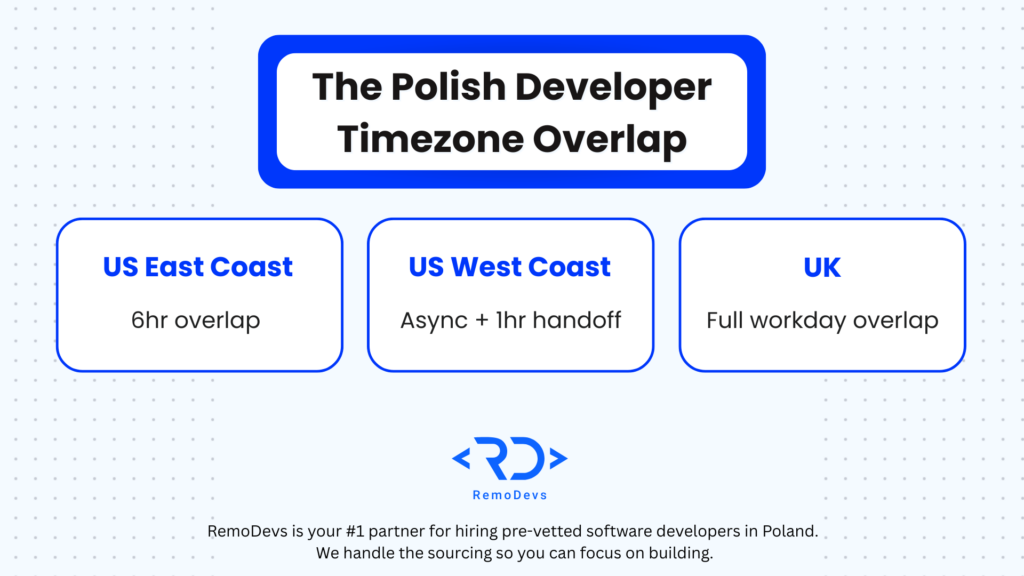
Frictionless collaboration relies on effective scheduling. Polish professionals operate in Central European Time (CET/CEST), providing excellent alignment with Western business hours.
| Team Location | Time Difference from Poland (CET/CEST) | Daily Overlap | Best Collaboration Activities |
|---|---|---|---|
| UK (GMT/BST) | 0–1 hour | Full workday | Standups, pair programming, workshops |
| US East Coast (ET) | 6 hours | 3–4 hours | Sprint planning, code reviews, demos |
| US Central (CT) | 7 hours | 2–3 hours | Daily syncs, handoffs |
| US West Coast (PT) | 9 hours | 1–2 hours | Handoffs, status updates, retrospectives |
- UK Teams: With only a 1-hour time difference (UK is GMT/BST), there is a full workday overlap. This allows for entirely synchronous communication, pair programming, and immediate feedback loops.
- US Teams (ET): CET/CEST is typically 6 hours ahead of US Eastern Time. This provides a highly productive 3-to-4-hour morning overlap for US teams, ideal for daily stand-ups and code reviews, while the Polish team completes focused, uninterrupted development before the US day begins.
- US Teams (PT): CET/CEST is typically 9 hours ahead of US Pacific Time. Teams manage this by utilizing asynchronous communication tools and establishing an hour-long overlap in the US morning (Polish late afternoon) to hand off tasks.
You can learn more about managing these logistical advantages in our guide to building your IT team in Poland.
Work Ethic and Western Business Alignment
Polish professionals share a strong cultural alignment with Western business standards. Because Poland is a member of the European Union, its tech market operates under strict data privacy laws, making GDPR compliance native to their daily workflow. There is a deeply rooted respect for intellectual property and data security.
This systemic reliability is a major reason why global tech giants – including Google, Microsoft, and Intel have invested heavily in establishing major R&D centers across Poland. The local work ethic prioritizes accountability, continuous learning, and delivering tangible business value.
How RemoDevs Vets for Soft Skills and Cultural Fit
Finding global talent is only part of the equation; ensuring they fit your specific team dynamic is where true value is created. At RemoDevs – top IT recruitment agency in Poland, we believe technical vetting is just the baseline.
Our rigorous, multi-stage assessment methodology specifically evaluates candidates beyond their code:
- Communication clarity: Behavioral assessments to gauge how efficiently candidates articulate technical challenges.
- Feedback loops: Live pair-programming interviews to observe how they receive peer code reviews and deliver constructive criticism.
- Team integration: In-depth cultural fit interviews to ensure their working style aligns with the client’s company culture.
This thorough process has consistently helped clients scale reliably, recently reducing average time-to-hire by 30-60 days while maintaining excellent retention rates. You can see the measurable ROI of our matching process in our case studies.
“The developers we hired through RemoDevs didn’t just write code; they actively improved our architecture. They integrated seamlessly into our Agile workflows from day one.” — CTO
Conclusion
Hiring Polish developers provides more than just extra hands on a keyboard. It integrates mature Agile practitioners into your workflow. By tapping into a talent pool characterized by fluent English, robust communication, and proactive problem-solving, you can accelerate your product roadmap without the friction typically associated with remote hiring.
FAQ
Is there a significant language barrier when working with Polish developers? No. Poland consistently ranks in the top tier globally in the EF English Proficiency Index. The vast majority of Polish developers are highly fluent in English and are accustomed to operating exclusively in English within international teams.
How do Polish developers handle timezone differences with the US? Polish developers (CET/CEST) typically have a 6-hour overlap with the US East Coast, allowing for synchronous morning meetings. For the West Coast (a 9-hour difference), teams successfully utilize asynchronous collaboration tools alongside specific, dedicated overlap windows for handoffs.
Are Polish developers familiar with Agile methodologies? Yes. Agile and Scrum frameworks are the industry standard across the Polish tech ecosystem. Developers are highly accustomed to iterative development, daily stand-ups, and sprint retrospectives.
Ready to scale your tech team without compromising on quality or culture? Schedule a consultation with RemoDevs today to connect with pre-vetted remote experts perfectly matched to your tech stack and workflow.
Visit us
Find a moment in your calendar and come to our office for a delicious coffee
Make an apointment