RemoDevs, Devire, Bee Talents, Next Technology Professionals and NTIATIVE are five recruitment providers to consider when hiring Node.js developers in Poland. The useful comparison is how each provider supports your search, which commercial model it offers, and how candidate evaluation will work for your role.
This guide is for employers building their own engineering teams. Hiring a developer through a recruitment agency, adding a contractor to a client-managed team, and commissioning a software company to deliver a project are different purchases.
All five providers have current recruitment offerings relevant to software engineering in Poland. Public evidence varies: a broad IT recruitment service, a Node.js hiring guide and a client account of a search establish different things. None alone proves that every presented developer has passed an engineering assessment.
1. RemoDevs
Relevant hiring scenario: International employers seeking a targeted Poland-based search for a backend specialist, including demanding combinations of skills.
RemoDevs supports international employers with technical recruitment across Poland. Its IT recruitment service covers senior engineering and niche skill combinations, with role calibration, targeted sourcing and recruiter screening. For a Node.js search, that gives the hiring team a way to align the shortlist with the actual backend work, seniority and working arrangements before committing engineering time to interviews.
A Clutch review describes a multi-stack recruitment engagement that included Node.js, alongside Java, Python and PHP. The client discusses candidate sourcing and call coordination. This supports relevant recruitment experience, rather than a Node.js-specific performance benchmark.
What this means for the hiring company:
- A search built around the role. Agree the essential backend experience and skill combinations, so frontend JavaScript experience alone is not the basis for a match.
- Polish market context and nationwide reach. Discuss candidate expectations and availability across Poland, with remote, hybrid or location-specific sourcing matched to the brief.
- A coordinated shortlist. Recruiter qualification and candidate context help your team decide whom to interview; candidate communication and interview coordination support the client-side evaluation process.
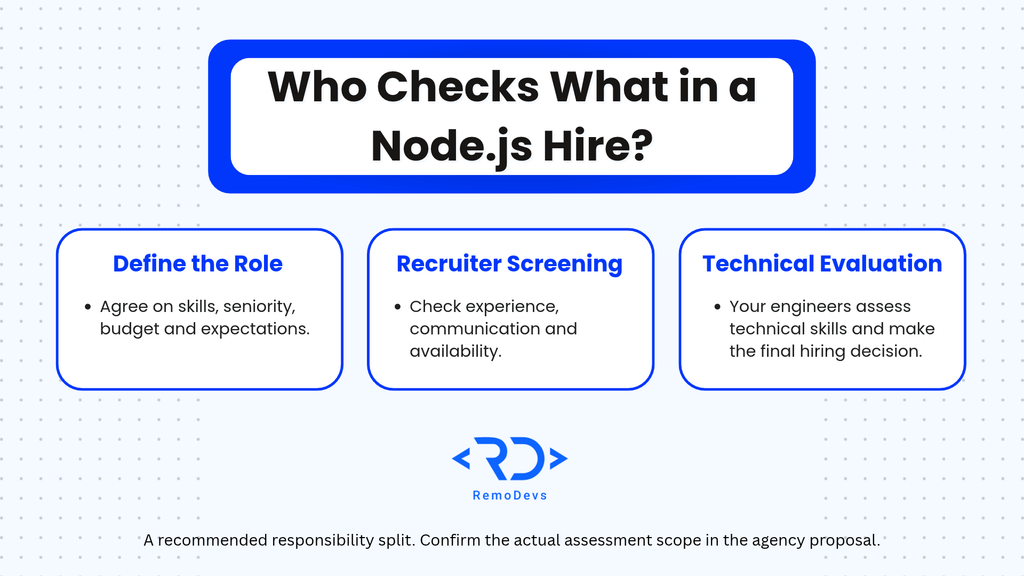
Success-fee recruitment is available, with terms agreed before the project starts. Recruiter screening covers experience, motivation, communication, availability and fit with the hiring context. Your engineering team leads the technical evaluation and final hiring decision.
2. Devire
Relevant hiring scenario: Companies comparing permanent software-engineering recruitment with a broader range of workforce services.
Devire offers permanent recruitment, IT contracting and RPO as separate services. Its IT and telecommunications recruitment page describes specialist consultants and software-development searches for startups, fintechs, software houses and multinational companies.
That breadth makes Devire relevant when a Node.js search sits within a wider hiring programme. Its specialist IT and telecommunications recruitment team is the relevant starting point, rather than treating all workforce services as one offer. The reviewed evidence establishes software-recruitment coverage, not an independently documented Node.js specialism.
Before engaging: establish which consultant will lead the backend search and whether the quote covers a direct hire or a contracting arrangement. A recruitment fee and a contractor’s billed rate cover different responsibilities and cannot be compared as equivalent prices.
3. Bee Talents
Relevant hiring scenario: Technology companies choosing between support for specific vacancies and additional recruiting capacity.
Bee Talents offers recruitment under retainer-fee and success-fee models, as well as RPO and recruitment consulting. Its published approach includes sourcing, behavioural interviews, reporting and process coordination. Alongside its published technology-client stories, a March 2021 Clutch interview with Codility’s CTO describes sourcing and hiring-process support. This is evidence of technology recruitment, not a Node.js-specific placement record.
The distinction between a role-specific search and an embedded recruiter is useful for a growing product team. One Node.js vacancy and a recurring pipeline of engineering hires may call for different engagement structures.
Before engaging: compare the commitment and deliverables of a role-specific retainer or success-fee search with RPO capacity, including reporting and hiring-manager involvement. Confirm relevant backend search experience for your vacancy.
4. Next Technology Professionals
Relevant hiring scenario: Employers comparing success-fee recruitment with an alternative IT outsourcing arrangement.
Next Technology Professionals provides permanent recruitment and IT outsourcing from Poland. Its current service description explains a success-fee recruitment model and a process that moves from requirements gathering and sourcing to recruiter interviews, client evaluation and support during contract discussions.
Its Node.js hiring page specifically describes sourcing for this technology. This is a provider-authored offer, not an independent benchmark of Node.js placement outcomes.
Before engaging: confirm whether you will engage the developer directly or buy the separate outsourcing service, along with the fee trigger and search scope. Its process places further interview stages with the client, so agree the engineering assessment explicitly.
5. NTIATIVE
Relevant hiring scenario: International employers comparing an individual engineering search with recurring recruitment or a wider Poland expansion.
NTIATIVE’s recruitment service covers specialist software roles and describes retained search, recruitment subscription and RPO options. Its company site also presents market-entry, HR, payroll and accounting support.
A September 2026 backend vacancy on its site describes a Poland-based search for a US technology company using Node.js, JavaScript and PostgreSQL. This is evidence of a relevant search, rather than a completed placement.
Before engaging: compare retained search with subscription or RPO support against the continuity of your vacancies. Keep any market-entry, legal-entity or payroll work separately scoped; broader services do not make an individual search unsuitable.
Comparison: Key Factors Across All Five Agencies
The table compares public offerings and evidence, not delivery performance. Commercial terms and assessment responsibilities should be confirmed for the same hiring brief.
| Agency | Publicly described recruitment options | Evidence relevant to a Node.js search | Main proposal decision |
|---|---|---|---|
| RemoDevs | Technical recruitment; success-fee option | Nationwide sourcing and role calibration; client review explicitly includes Node.js in a multi-stack search | Targeted backend shortlist, Polish market context and client interview coordination |
| Devire | Permanent recruitment, IT contracting and RPO | Specialist IT/telecommunications team; no independently documented Node.js specialism in reviewed sources | A backend search within a broader workforce programme; direct hire versus contracting |
| Bee Talents | Retainer-fee or success-fee recruitment; RPO | Technology-client work, including Codility’s client account; not a Node.js placement benchmark | Role-specific RF/SF engagement versus embedded recruiting capacity |
| Next Technology Professionals | Permanent recruitment; separate IT outsourcing offer | Public Node.js hiring offer and recruitment process | Engagement model, fee trigger and client interview stages |
| NTIATIVE | Retained search, recruitment subscription and RPO | Specialist software recruitment and a published Node.js backend search | Individual hire, ongoing recruitment or wider expansion support |
There is no common, independently verified dataset here for shortlist speed, Node.js technical pass rates or replacement terms. A useful proposal should explain those items in the context of your vacancy rather than rely on a generic comparison score.
Why International Tech Companies Consider Node.js Developers in Poland
For an international employer, the practical question is whether a Poland-based search fits the product, working arrangements and budget. An agency can help test those assumptions against candidate expectations before you commit to a narrowly defined search.
Location and collaboration. Set the required working-hour overlap explicitly. A fully remote role can support a nationwide search; regular office attendance creates a different location constraint. English communication and remote collaboration should be assessed with each candidate through discussion of actual work, handovers and technical decisions.
Engagement arrangements. State whether you are considering employment or a business-to-business services agreement, and which entity would engage the person. Confirm the arrangement and cross-border obligations with the relevant advisers. Recruitment support does not automatically include payroll, employer-of-record services or legal advice.
Compare the Same Cost Categories
| Budget item | What to establish before comparing proposals |
|---|---|
| Employment compensation | Gross salary, benefits and employer costs relevant to your arrangement |
| Direct B2B engagement | Currency, billing unit, VAT treatment, expected availability and contractual scope |
| Recruitment fee | Calculation basis, payment trigger, exclusivity and any replacement conditions |
| Staff augmentation | Customer-billed rate, included supplier responsibilities and client management of delivery |
Use comparable role requirements and contract assumptions. A US salary-plus-benefits estimate and a Polish contractor invoice do not by themselves establish a like-for-like saving.
What to Actually Look for in a Polish Node.js Recruitment Agency
Before evaluating agencies, define what the engineer will own. Years of JavaScript experience alone do not establish readiness to maintain a production Node.js backend.
- Role fit. Compare how each agency translates your essential stack and production responsibilities into sourcing criteria, including relevant communication and availability requirements.
- Assessment ownership. Recruiters qualify relevant experience and hiring fit; your engineers validate coding, design and production judgement. Agree the split in the proposal.
- Written terms. Compare the fee basis, payment trigger, exclusivity and any replacement conditions for the same scope.
Use the following areas to check whether a provider understands your role and to plan the client-led assessment. The Node.js TypeScript introduction explains why static types do not replace runtime input validation; the official guide to blocking the event loop or worker pool explains a key production-performance concern.
| Area | Evidence to seek in a client-led technical interview |
|---|---|
| Node.js and TypeScript | Handling asynchronous failures, diagnosing blocking work, and distinguishing type checking from runtime validation |
| APIs and architecture | Authentication and authorization boundaries, input validation, error handling and appropriate service boundaries |
| Data and integration | Query behaviour and transactions in your database; caching, queues or retries where the product needs them |
| Production ownership | Tests, observability, deployment, incident investigation and dependency maintenance |
| Senior or lead responsibilities | Design trade-offs, mentoring, code review and ownership across teams, supported by concrete project examples |
For example, a TypeScript API role using NestJS or Express and PostgreSQL needs a different search brief from a full-stack position centred on React with occasional backend changes. Redis, RabbitMQ, cloud platforms and microservices belong in the brief when the role uses them, rather than as a universal list of requirements.
How a Node.js Recruitment Process Should Work
Before appointing an agency, request an anonymized example of a candidate presentation and a short outline of the proposed workflow. Check whether the presentation connects experience to your Node.js brief, records availability and expectations, and identifies open technical questions for your team.
Then agree how feedback on the first profiles will adjust the search, who coordinates interviews and when you receive progress updates. These details make a proposal easier to evaluate than an unexplained “fully vetted” label. This is a buyer’s evaluation framework, not a claim that every provider follows identical stages.
Prepare Your Node.js Hiring Brief
Send shortlisted agencies the same brief: what the developer will deliver, must-have backend experience, TypeScript and framework requirements, seniority, budget, engagement model, location, working-hour overlap and your technical interview plan. Request a proposal that states sourcing scope, screening responsibilities, commercial terms and the next steps.
For a nationwide Node.js search, discuss your hiring requirements with RemoDevs. We can help calibrate the role, source relevant candidates and coordinate the recruitment process while your team leads the technical hiring decision.
Visit us
Find a moment in your calendar and come to our office for a delicious coffee
Make an apointment