
- Poland ranks 15th globally on the latest EF English Proficiency Index (2025/2026), breaking into the elite “Very High Proficiency” tier – well above most nearshore and offshore tech hubs.
- Polish developers in international tech environments typically hold B2 to C1 level English (Upper-Intermediate to Advanced), which is more than sufficient for daily standups, code reviews, and asynchronous collaboration.
- Fluency varies significantly based on seniority, educational background, and international exposure – making pre-screening critical.
- Hiring through a rigorous vetting partner eliminates the guesswork. You get developers whose communication skills have already been stress-tested, not discovered on your first sprint call.
How Well Do Polish Software Developers Communicate in English at Work?
You aren’t hiring a translator. You’re hiring a Senior Backend Engineer who needs to write clear Jira tickets, push back on bad architecture decisions, and explain a production incident to a non-technical stakeholder at 2 AM.
That’s a completely different bar than “conversational English.”
The honest answer? Most Polish developers can hold a technical conversation. But the top-tier ones – the engineers you actually want – communicate in English with the fluency and precision you’d expect from a strong in-house hire in Austin or Toronto.
Here is the data, the context, and the red flags to watch for so you can make a confident hiring decision.
Poland’s English Proficiency: The Data
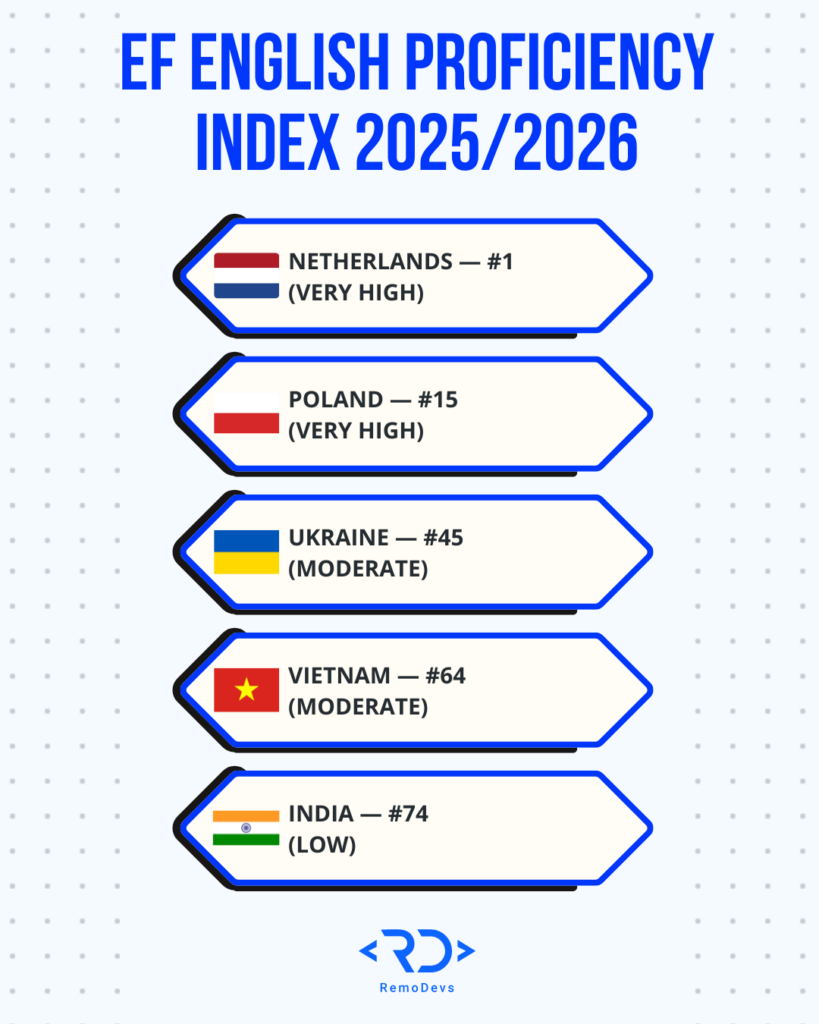
The EF English Proficiency Index is the world’s largest ranking of non-native English-speaking countries, covering over 120 nations. Based on the latest report, Poland has officially moved into the highest possible tier of proficiency.
| Country | EF EPI Score | Proficiency Tier | Global Rank |
| Netherlands | 624 | Very High | 1 |
| Poland | 600 | Very High | 15 |
| Philippines | 569 | High | 28 |
| Ukraine | 526 | Moderate | 45 |
| Vietnam | 500 | Moderate | 64 |
| India | 484 | Low | 74 |
Poland outranks every major offshore development hub outside of Northern Europe. It also consistently outscores countries frequently marketed as “English-speaking” tech destinations.
Why Polish Tech Talent Trends Higher Than the National Average
The national EF score reflects the general population. Polish software developers skew significantly higher for three key reasons:
- English-First STEM Education: University computer science programs in Poland heavily rely on English-language textbooks, documentation, and research papers from day one.
- An Export-Driven Tech Industry: The majority of Polish software houses and product companies serve US and Western European clients. English isn’t a nice-to-have; it’s a baseline requirement for employment.
- Immersive Remote Work: Polish developers working remotely for international teams spend 40+ hours a week fully immersed in English-speaking environments.
What “High Proficiency” Looks Like in Practice
Most Polish developers you encounter during a serious hiring process will sit at one of these levels:
| CEFR Level | Engineering Profile | Typical Capabilities |
| B1 (Intermediate) | Junior Devs (0–2 yrs international exposure) | Can discuss familiar technical topics; may make grammatical errors under pressure. |
| B2 (Upper-Intermediate) | Mid-Level Devs (2+ yrs international exposure) | Handles complex technical topics smoothly; highly comfortable in async written comms. |
| C1 (Advanced) | Senior/Lead Devs | Near-fluent and nuanced; can confidently lead meetings and write client-facing documentation. |
| C2 (Mastery) | Exceptional / Rare | Indistinguishable from a native speaker in a professional context (often studied/worked abroad). |
For most engineering roles, B2 is the functional minimum. C1 becomes critical for Lead, Staff, and Principal-level hires who interact directly with business stakeholders or run technical discovery calls.
The ROI of Strong English on Your Team
- Async-first workflows actually work. Pull request comments, Notion docs, and Slack threads require zero “lost-in-translation” overhead.
- Standups stay on schedule. Product managers don’t have to pause to interpret or re-explain concepts.
- Incident response is cleaner. A developer who can write a coherent post-mortem in English saves hours of back-and-forth.
- Cultural fit lands faster. Polish engineers tend to mirror the directness, dry humor, and context-aware communication style of US tech teams more closely than developers from high-context cultures.
Where English Proficiency Falls Short (And How to Spot It)
Not every Polish developer is a C1 communicator. The proficiency spread is real, and ignoring it leads to bad hires. Language skills typically drop when a developer has only worked in domestic Polish companies, specializes in a niche with a limited global community (like localized government tech), or is fresh out of a bootcamp.
Red Flags During the Hiring Process
Watch for these signals during your screening:
- Long pauses before every answer: Often indicates the candidate is translating in real-time rather than thinking in English.
- Monosyllabic responses: Hearing only “Yes,” “Correct,” or “Agree” when you ask open-ended questions that require reasoning.
- Perfect written English, broken spoken English: Some candidates rely heavily on AI tools to polish async communication but struggle in live calls. Always test both.
- Avoidance of pushback: A strong engineer should be able to disagree with you politely in English. If they lack the vocabulary to do so, you’ll find out the hard way during your first architecture review.
How RemoDevs Eliminates the Language Risk
English proficiency isn’t just a checkbox on our screening form – it is stress-tested across multiple touchpoints.
We filter out 90% of applicants at the initial stage. The 10% who make it to your shortlist have already cleared:
- Live, English-Language Technical Interviews: Not a written assessment, but a real-time conversation with our senior technical recruiters.
- Targeted Soft Skills Evaluation: We probe for communication under ambiguity, the ability to ask clarifying questions, and async writing quality.
- International Reference Checks: We explicitly ask previous international clients about the developer’s communication habits, not just their code delivery.
- Cultural Mapping: We align the developer’s working style to your team’s specific dynamic (e.g., async-heavy vs. meeting-heavy, structured vs. scrappy).
We treat every search as if we’re hiring for our own team. We will never send you a developer who is technically brilliant but communicates at a B1 level and will frustrate your engineering org within 60 days.
You don’t have to take our word for it – you’ll hear the difference in the first 15 minutes of your call with a RemoDevs candidate.
The Bottom Line
Polish developers represent one of the strongest combinations in the global tech talent market: high technical depth, European time zone overlap with the US East Coast, and proven English proficiency backed by hard data.
The real risk isn’t that “Polish developers can’t speak English.” The risk is hiring any developer without properly vetting their communication skills. That is an operational problem, not a geographical one.
Solve the ops problem once by working with a recruitment partner built specifically to eliminate that risk at the source.
Ready to See Who Made the Cut?
Book a free 15-minute discovery call with RemoDevs.
We’ll walk you through a shortlist of pre-vetted Polish developers matched to your stack, seniority level, and communication requirements. No pitch deck. No filler candidates. Just the top 10% – already screened for everything we just talked about.
👉 Schedule Your 15-Minute Call →
You’ll have a customized shortlist in your inbox within 5 business days.
Visit us
Find a moment in your calendar and come to our office for a delicious coffee
Make an apointment